
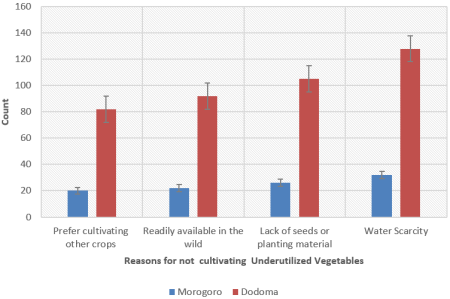
Underutilized Vegetables (UVs) are nutrient dense crops with substantial potential to enhance food security and dietary diversity, yet remain largely overlooked in mainstream agriculture. This study aimed to investigate the diversity, domestication and cultivation practices of UVs in Morogoro and Dodoma regions of Tanzania through across sectional survey of 307 respondents. Chi- square test was performed to assess associations between categorical variables such as Dodoma and Morogoro. 30 species of underutilized vegetables consumed both in Morogoro and Dodoma regions were identified. Overall, 75.6% (n=232) of respondents demonstrated high familiarity with UVs, reflecting their cultural and dietary relevance. Domestication rates varied significantly by region, 83.2 % (99/119) of Morogoro farmers reported cultivating UVs in home gardens, compared with just 29.3%(55/188) in Dodoma with a highly significant difference (χ² = 84.805, p =0.000). The main reason hindering UVs domestication was water scarcity in semi-arid Dodoma (68%), as well as the availability of underutilized vegetables in wild areas. Multiple linear regression analysis was performed to further identify factors that independently influenced the respondents’ practices score. Region, age, and education level affected the practices score, with regression p-values of 0.001, 0.021, and 0.014 respectively. In Morogoro, 54 respondents (n = 119) achieved higher GAP scores, while none in Dodoma did. These interregional disparities appear to be driven by differential access to water resources, extension services, and functional market linkages. These findings underscore the need for targeted interventions, including water management strategies in semi-arid Dodoma, Community based training, seed multiplication initiatives and integrating UVs into national research, policy and market development frameworks. Such efforts could transform UVs from neglected wild forages into climate resilient, nutrient-rich crops, enhancing both sustainable agriculture and nutrition security in Tanzania.
| Published in | Journal of Food and Nutrition Sciences (Volume 13, Issue 6) |
| DOI | 10.11648/j.jfns.20251306.14 |
| Page(s) | 334-352 |
| Creative Commons |
This is an Open Access article, distributed under the terms of the Creative Commons Attribution 4.0 International License (http://creativecommons.org/licenses/by/4.0/), which permits unrestricted use, distribution and reproduction in any medium or format, provided the original work is properly cited. |
| Copyright |
Copyright © The Author(s), 2025. Published by Science Publishing Group |
Underutilized Vegetables, Domestication, Good Agricultural Practices, Food Security
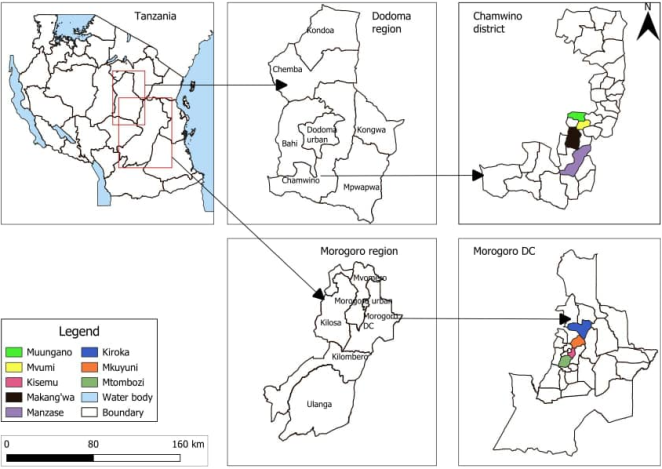
Morogoro Region | Respondent Expected | Respondents Observed | Dodoma Region | Respondent Expected | Respondents Observed |
|---|---|---|---|---|---|
Kiroka (Kiroka A) | 43 | 35 | Mvumi mission (Mvumi mission) | 79 | 62 |
Mkuyuni (Mkuyuni) | 41 | 33 | Muungano (Ilolo) | 53 | 42 |
Kisemu (Kangazi) | 33 | 26 | Makangwa (Makangwa) | 36 | 28 |
Mtombozi (mtombozi kazi) | 32 | 25 | Manzase (Manzase) | 68 | 54 |
Subtotal | 149 | 119 | 236 | 188 | |
Total Respondent | 307 | 385 |
Variables | Categories | Morogoro | Dodoma | Chi-squares | p-value |
|---|---|---|---|---|---|
Sex | Female | 83 (69.7%) | 167 (88.8%) | 17.550 | 0.000*** |
Male | 36 (30.3%) | 21 (11.2%) | |||
Education Level | None | 15 (12.6%) | 55 (29.3%) | 11.659 | 0.003** |
Primary education | 83 (69.7%) | 109 (58.0%) | |||
Secondary education | 21 (17.6%) | 24 (12.8%) | |||
Marital Status | Divorced | 6 (5.0%) | 1 (0.5%) | 13.034 | 0.023* |
Married | 80 (67.2%) | 143 (76.1%) | |||
Prefer not to say | 2 (1.7%) | 1 (0.5%) | |||
Separated | 3 (2.5%) | 0 (0.0%) | |||
Single | 16 (13.4%) | 24 (12.8%) | |||
Widowed/widower | 12 (10.1%) | 19 (10.1%) | |||
Occupation | Employed | 3 (2.5%) | 0 (0.0%) | 4.846 | 0.089ns |
Farmer | 114 (95.8%) | 184 (97.9%) | |||
Trader | 2 (1.7%) | 4 (2.1%) | |||
Monthly Income | More than 300,000 | 1 (0.8%) | 0 (0.0%) | 2.388 | 0.303ns |
100,000-300,000 | 13 (10.9%) | 15 (8.0%) | |||
Less than 100,000 | 105 (88.2%) | 173 (92.0%) | |||
Native to the village | No | 8 (6.7%) | 23 (12.2%) | 2.438 | 0.118ns |
Yes | 111 (93.3%) | 165 (87.8%) |
Region | Native Name | Scientific Name | Swahili Name | Percent% |
|---|---|---|---|---|
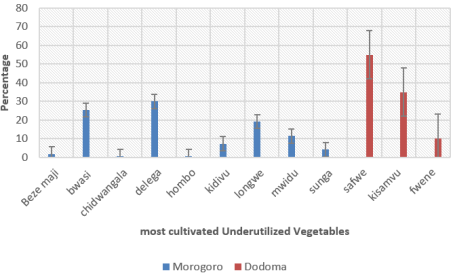
Morogoro | Mwidu | Justicia heterocarpa | Mlenda Mwidu | 104(87.40) |
Delega | Basella alba | Delega | 100(84.00) | |
Sunga | Launea cornuta | Chunga | 92(77.30) | |
Hombo | Corchorus spp | Mlenda hombo | 81(68.10) | |
Bwasi | Amaranthus spp | Mchicha pori | 80(67.20) | |
Chidwangala | Vigna vexillata | Kunde pori | 61(51.30) | |
Mbwembwe | Bidens pilosa | Shona nguo | 60(50.40) | |
Kisamvu | Manihot grazioli | Kisamvu | 53(44.50) | |
Longwe | Ipomoea pandurata | Tembele pori | 53(44.50) | |
Kidivu | Unidentified | Kidivu | 48(40.30) | |
Bezemaji | Unidentified | Majani ya magimbi | 34(28.60) | |
Mwage | Sesbania spp | Mlenda mwage | 23(19.30) | |
Lubi | Unidentified | Lubi | 8(6.70) | |
Mnavu pori | Solanum incanum | Mnavupori | 8(6.70) | |
Mokamoka | Unidentified | Mokamoka | 4(3.40) | |
Mlenda mgunda | Corchorus spp | Mlenda mgunda | 1(0.80) | |
Dodoma | Ilende | Corchorus trilocularis | Mlenda wakigogo | 177(94.70) |
Safwe | Vigna unguiculata | Majani ya kunde | 167(88.80) | |
Fwene | Amaranthus graecizans | Mchicha pori | 164(87.20) | |
Chiwandagulu | Ipomoea pandurata | Matembele pori | 162(86.70) | |
Ngazi | Unidentified | Ngazi | 132(70.20) | |
Kidingulilu | Unidentified | Maua ya alovera | 129(68.60) | |
Mzimwe | Cleome gynandra | Mgagani | 101(53.70) | |
Mhilile | Cleome hirta | Mhilile | 99(52.70) | |
Kisamvu | Manihot grazioli | Kisamvu | 81(42.60) | |
Sagulasagula | Ipomoea mombassana | Sagula sagula | 67(36.70) | |
Chipalii | Ipomoea obscura | Jamii ya matembele | 42(22.50) | |
Ikui | Adansonia digitata | Majani ya mbuyu | 30(16.00) | |
Kalabwagila | Cucurbita maxima | Majani ya maboga | 5(2.70) | |
Sansa | Vigna spp | Sansa | 4(2.10) |
Familiarity level | Score range | Number of respondents | Percent% |
|---|---|---|---|
Unfamiliar < | < 7 | 75 | 24.40 |
familiar ≥ | ≥7 | 232 | 75.60 |
Total | 307 | 100 |
Region | (n) | Available in all seasons | Available only in rainy season | Chi-square (χ²) | Sig. |
|---|---|---|---|---|---|
Morogoro | 119 | 13(10.9%) | 106(89.1%) | 10.78 | .001 |
Dodoma | 188 | 4(2.1%) | 184(97.9%) |
Source | Morogoro | Dodoma | χ² | p-value | ||
|---|---|---|---|---|---|---|
Yes (%) | No (%) | Yes (%) | No (%) | |||
Wild areas | 116(97.5) | 3(2.5) | 188(100) | 0(0) | 4.786 | 0.029 |
Market | 85 (71.4) | 34 (28.6) | 0 (0.0) | 188 (100) | 185.701 | 0.000 |
Home Gardens | 103 (86.5) | 16 (13.5) | 3 (1.6) | 185 (98.4) | 232.680 | 0.000 |
Sources | Morogoro | Dodoma | χ² | p-value | ||
|---|---|---|---|---|---|---|
Yes (%) | No (%) | Yes (%) | No (%) | |||
Wild Areas | 100 (84.0) | 19 (16.0) | 35 (18.6) | 153 (81.4) | 26.089 | 0.000 |
Home Gardens | 73 (61.3%) | 46 (38.7) | 3 (1.6) | 185 (98.4) | 139.661 | 0.000 |
Market | 75 (63.0%) | 44 (37.0%) | 4 (2.1) | 184 (97.9) | 141.410 | 0.000 |
Home Storage | 0 (0.0%) | 188 (100%) | 182 (96.8) | 6 (3.2) | 282.936 | 0.000 |
Variable | Category | Are you cultivating underutilized vegetables in your home garden | Test statistics | Are you willing to domesticate underutilized vegetables | Test statistics | ||||
|---|---|---|---|---|---|---|---|---|---|
No | Yes | Chi-square | P-Value | No | Yes | Chi-square | P-Value | ||
Region | Morogoro | 20 (16.8%) | 99 (83.2%) | 84.805 | 0.000 | 2 (10.5%) | 17 (89.5%) | 0.189 | 0.664 |
Dodoma | 133 (70.7%) | 55 (29.3%) | 10 (7.6%) | 121 (92.4%) | |||||
Variable | Category | Freq. | Percent (%) |
|---|---|---|---|
What steps do you take to prepare the land before planting underutilized vegetables | Clear the land, plough, harrow, and apply manure before planting | 39 | 25.3 |
Clear the land and plant directly without ploughing or harrowing | 43 | 27.9% | |
Clear the land, plough, harrow, and plant directly | 71 | 46.1% | |
No specific preparation; plant directly on existing land conditions | 1 | 0.6% | |
Where do you usually obtain seeds for planting underutilized vegetables | |||
Local markets (unregulated) | No | 95 | 93.1% |
Yes | 7 | 6.9% | |
Certified seed sources (e.g., seed banks, research institutes) | No | 102 | 100% |
Yes | 0 | 0% | |
Self-saved seeds from previous harvests | No | 25 | 24.5% |
Yes | 77 | 75.5% | |
How often do you irrigate underutilized vegetables during the dry season? | Daily | 58 | 61.7% |
2–3 times per week | 24 | 25.5% | |
weekly | 2 | 2.1% | |
Morning and evening | 10 | 10.6% | |
Do you use any soil amendments (e.g., compost, manure) when growing or managing underutilized vegetables? | No | 66 | 55.9% |
Yes | 51 | 43.2% | |
Sometimes | 1 | 0.8% | |
What type of fertilizers do you use for underutilized vegetables | Organic | 79 | 51.3% |
Inorganic | 1 | 0.6% | |
Both | 5 | 3.2% | |
None | 69 | 44.8% | |
How do you manage pests and diseases in underutilized vegetables | None | 172 | 81.5% |
Organic pesticides | 36 | 17.1% | |
Chemical pesticides | 3 | 1.4% | |
What signs or indicators do you use to determine when to harvest these vegetables | |||
Tenderness of the leaves | No | 66 | 21.6% |
Yes | 239 | 78.4% | |
The size of the leaves | No | 145 | 47.5% |
Yes | 160 | 52.5% | |
Age of the leaves | No | 243 | 79.7% |
Yes | 62 | 20.3% | |
Color change of the leaf | No | 232 | 76.1% |
Yes | 73 | 23.9% | |
How do you harvest these vegetables | |||
By Handpicking | No | 0 | 0% |
Yes | 307 | 100% | |
By Using a knife or sickle | No | 305 | 99.3% |
Yes | 2 | 0.7% | |
By Uprooting | No | 240 | 78.2% |
Yes | 67 | 21.8% | |
At what time of the day do you harvest underutilized vegetables | |||
Morning | No | 140 | 45.6% |
Yes | 167 | 54.4% | |
Afternoon | No | 302 | 98.4% |
Yes | 5 | 1.6% | |
Evening | No | 253 | 82.4% |
Yes | 54 | 17.6% | |
Anytime | No | 152 | 49.5% |
Yes | 155 | 50.5% | |
Depending on the weather conditions | No | 303 | 98.7% |
Yes | 4 | 1.3% | |
Would you be willing to adopt improved farming practices if training or support is provided? | No | 139 | 45.3% |
Yes | 168 | 54.7% | |
Factors | Category | Practice score | Test statistics | |||
|---|---|---|---|---|---|---|
Poor (<=35%) | Medium (36%-65%) | Good (>=66%) | χ2 P-Value | Regression P-value | ||
Region | Morogoro | 31(15.9%) | 34(58.6%) | 54(100.0%) | <0.001 | <0.001 |
Dodoma | 164(84.1%) | 24(41.4%) | 0(0.0%) | |||
Age | 15-19 | 10(5.1%) | 1(1.7%) | 0(0.0%) | 0.004 | 0.021 |
20-39 | 68(34.9%) | 20(34.5%) | 24(44.4%) | |||
40-59 | 75(38.5%) | 25(43.1%) | 25(46.3%) | |||
Above 60 | 42(21.5%) | 12(20.7%) | 5(9.3%) | |||
Gender | Male | 25(12.8%) | 16(27.6%) | 16(29.6%) | 0.309 | 1 |
Female | 170(87.2%) | 42(72.4%) | 38(70.4%) | |||
Education Level | None | 51(26.2%) | 17(29.3%) | 2(3.7%) | 0.01 | 0.014 |
Primary education | 124(63.6%) | 28(48.3%) | 39(72.2%) | |||
Secondary education | 20(10.3%) | 13(22.4%) | 13(24.1%) | |||
Occupation | Farmer | 188(97.4%) | 56(96.6%) | 52(96.3%) | 0.059 | 0.219 |
Employed | 0(0.0%) | 1(1.7%) | 2(3.7%) | |||
Trader | 5(2.6%) | 1(1.7%) | 0(0.0%) | |||
Monthly Income | Less than 100,000 | 180(92.3%) | 45(77.6%) | 53(98.1%) | 0.01 | 0.06 |
100,000-300,000 | 15(7.7%) | 12(20.7%) | 1(1.9%) | |||
More than 300,000 | 0(0.0%) | 1(1.7%) | 0(0.0%) | |||
Uvs | Underutilized Vegetables |
GAP | Good Agricultural Practices |
FAO | Food and Agriculture Organization of the United Nations |
ILVs | Indigenous Leafy Vegetables |
KAP | Knowledge Attitude and Practice |
TZS | Tanzania Shillings |
VEOs | Village Executive Officers |
WHO | World Health Organization |
UVs | Underutilized Vegetables |
| [1] | Adewoyin, Oluyinka Benedicta. 2023. “Pre-Harvest and Postharvest Factors Affecting Quality and Shelf Life of Harvested Produce.” In New Advances in Postharvest Technology, IntechOpen. |
| [2] | Alulu, J., Makyao, M., Huyskens-Keil, S., Lenz, B., Muendo, K. M., Mganilwa, Z., ... & Mithöfer, D. (2023). Distribution, transportation, and coordination in African indigenous vegetables value chains: A scoping review. Frontiers in Environmental Economics, 2, 1113826. |
| [3] | Alunga, Jane Udali, and Murunga Jaluo William. 2013. “Gender Roles and Agribusiness in the Kenyan Communities : The Case of Likuyani District Corresponding Author : Murunga Jaluo William.” Journal of Emerging Trends in Educational Research and Policy Studies 4(5): 733–38. |
| [4] | Issa-Zacharia, A., Majaliwa, N. K., Nyamete, F. A., & Chove, L. M. (2024). Diversity of underutilised vegetables in Africa and their potential in the reduction of micronutrient deficiency: a review. World Journal of Food Science and Technology, 8(1), 1-13 |
| [5] | Atuna, R. A., Djah, J., Achaglinkame, M. A., Bakker, S., Dari, L., Osei-Kwarteng, M., ... & Amagloh, F. K. (2022). Types of indigenous vegetables consumed, preparation, preferences and perceived benefits in Ghana. Journal of Ethnic Foods, 9(1), 38. |
| [6] | Ayenan, M. A., Aglinglo, L. A., Zohoungbogbo, H. P., N'Danikou, S., Honfoga, J., Dinssa, F. F., ... & Afari-Sefa, V. (2021).“Seed Systems of Traditional African Vegetables in Eastern Africa: A Systematic Review.” Frontiers in Sustainable Food Systems 5(September): 1–12 |
| [7] | Babayemi, B. A., and O. T. Adepoju. 2020. “Dietary Fibre and Micronutrient Potential of Underutilized Green Leafy Vegetable Sprinkles on Selected Foods.” Journal of Applied Sciences and Environmental Management 24(8): 1391–96. |
| [8] | Blakstad, M. M., Mosha, D., Bellows, A. L., Canavan, C. R., Chen, J. T., Mlalama, K., ... & Fawzi, W. W. (2021). Home gardening improves dietary diversity, a cluster‐randomized controlled trial among Tanzanian women. Maternal & Child Nutrition, 17(2), e13096. |
| [9] | Bokelmann, Wolfgang, Susanne Huyskens-Keil, Zoltan Ferenczi, and Silke Stöber. 2022. “The Role of Indigenous Vegetables to Improve Food and Nutrition Security: Experiences From the Project HORTINLEA in Kenya (2014–2018).” Frontiers in Sustainable Food Systems 6(April): 1–19. |
| [10] | Chacha, J. S., & Laswai, H. S. (2020). Micronutrients potential of underutilized vegetables and their role in fighting hidden hunger. International Journal of Food Science, 2020(1), 9408315. |
| [11] | Chacha, J. S., & Laswai, H. S. (2020). Traditional practices and consumer habits regarding consumption of underutilised vegetables in Kilimanjaro and morogoro regions, Tanzania. International Journal of Food Science, 2020(1), 3529434. |
| [12] | Chivenge, Pauline, Tafadzwanashe Mabhaudhi, and Albert T Modi. 2015. “The Potential Role of Neglected and Underutilised Crop Species as Future Crops under Water Scarce Conditions in Sub-Saharan Africa.”: 5685–5711. |
| [13] | Daley, Oral, Wendy-Ann Isaac, Afiya John, and İbrahim Kahramanoğlu. 2023. “Preharvest Factors, Maturity Indices and Postharvest Physiology of Fruits and Vegetables.” In Postharvest Physiology and Handling of Horticultural Crops, CRC Press, 3–35. |
| [14] | Desta Fekadu Mijena1, Sentayehu Alamerew2, Kebebew Assefa3, and Mandefro Nigusse 4 1, 3. 2024. “Indigenous and Underutilized Crops Significance in Food and Nutritional Security in the Face of Climate Change :” 12(2). |
| [15] | Etèka, C. A., Ahohuendo, B. C., Dansi, M., Assogba-Komlan, F., Vodouhe, R. S., Ahoton, L. E., ... & Hounhouigan, J. (2011). Diversity, cultural practices and domestication of Sesamum radiatum Thonn. ex Hornem and Justicia tenella (Nees) T., two neglected and underutilized traditional leafy vegetables consumed in Benin. |
| [16] | Fasina, Olusegun Oluwatosin 1, Tehinloju, Olanrewaju Abidemi2 and Adesida, Ireti Emmanuel. 2024. “Use of Good Agricultural Practices among Cassava Farmers in Southwest, Nigeria.”: 89–94. |
| [17] | Gil, M. I., J. A. Tudela, A. Martínez-Sánchez, and M. C. Luna. 2012. “Harvest Maturity Indicators of Leafy Vegetables.” Stewart Postharvest Review 8(1): 1–9. |
| [18] | Gowele, V. F., Kinabo, J., Jumbe, T., Rybak, C., & Stuetz, W. (2021). High prevalence of stunting and anaemia is associated with multiple micronutrient deficiencies in school children of small-scale farmers from Chamwino and Kilosa districts, Tanzania. Nutrients, 13(5), 1576. |
| [19] | Hansen, L. S., Sorgho, R., Mank, I., Nayna Schwerdtle, P., Agure, E., Bärnighausen, T., & Danquah, I. (2022). Home gardening in sub‐Saharan Africa: A scoping review on practices and nutrition outcomes in rural Burkina Faso and Kenya. Food and Energy Security, 11(3), e388 |
| [20] | James, Armachius, and Athanasia Matemu. 2016. “Solar-Drying of Vegetables for Micronutrients Retention and Product Diversification.” American Journal of Research Communication 4(8): 1–13. |
| [21] | Kaale, Lilian Daniel. 2023. Changing Dietary Patterns, Indigenous Foods, and Wild Foods Changing Dietary Patterns, Indigenous Foods, and Wild Foods. |
| [22] | Kansiime, Monica K, Piet van Asten, and Koen Sneyers. 2018. “Farm Diversity and Resource Use Efficiency: Targeting Agricultural Policy Interventions in East Africa Farming Systems.” NJAS-Wageningen Journal of Life Sciences 85: 32–41. |
| [23] | Kayg, Tansel, Bülent Yağmur, Mehmet Kadri Bozokalfa, and Dursun Eşiyok. 2021. “Nutritional Diversity of Underutilized Plant Species Collected from Aegean Region Of.” |
| [24] | Khatoniar, Sushmita, Mridula Saikia Barooah, and Mamoni Das. 2019. “Effect of Different Drying Methods on Micronutrient Content of Selected Green Leafy Vegetables.” International Journal of Current Microbiology and Applied Sciences 8(07): 1317–25. |
| [25] | Knez, Marija et al. 2023. “Causes and Conditions for Reduced Cultivation and Consumption of Underutilized Crops: Is There a Solution?” Sustainability (Switzerland) 15(4): 1–15. |
| [26] | Kock, K T. 2020. “The Influence of Culture on the Utilization of Traditional Leafy Vegetables among VaTsonga and Ba-Pedi Women of Bushbuckridge, Mpumalanga Province.” |
| [27] | Luzia Karin Deißler, Henning Krause, Ulrike Grote1. 2021. “Gender Dynamics and Food Security in the Kenyan African Indigenous Vegetables Supply Chain.” AgEcon Search: 18. file:///F:/Spec 2/Traffic Delay Model.pdf. |
| [28] | Lys, Irakoze Marie. 2025. “The Role of Lactic Fermentation in Ensuring the Safety and Extending the Shelf Life of African Indigenous Vegetables and Its Economic Potential.” Applied Research 4(1): e202400131. |
| [29] | Mabhaudhi, T., Chimonyo, V. G. P., Hlahla, S., Massawe, F., Mayes, S., Nhamo, L., & Modi, A. T. (2019). “Prospects of Orphan Crops in Climate Change.” Planta 250(3): 695–708. |
| [30] | Maden, Edwin van der, Edmond Ringo, and Eunice Likoko. 2021. Scoping Study on Fruits and Vegetables: Results from Tanzania. |
| [31] | Marrelli, Mariangela, Giancarlo Statti, and Filomena Conforti. 2020. “A Review of Biologically Active Natural Products from Mediterranean Wild Edible Plants: Benefits in the Treatment of Obesity and Its Related Disorders.” Molecules 25(3). |
| [32] | Marsh, Sir John,Wiggins, S., Eagle, M. D., Saleh, N., Studer, C., Barker, I., Jones, R., ... & Logan, M. J. (2020). The sustainable intensification of smallholder farming systems. |
| [33] | Mativavarira, M., Simango, K., Dube, P., Gasura, E., Savadye, D. T., & Mujaju, C. (2024).“Opportunities for African Indigenous Vegetables (AIVs): Regulations in the Vegetable Seed Sector in Sub Saharan Africa.” CABI Agriculture and Bioscience 5(1): 1–16. |
| [34] | Mbatha, K. C., S. Mavengahama, and N. R. Ntuli. 2022. “Potential of Domesticating the Underutilized Multipurpose Wild Leafy Vegetable, Sesamum Alatum, under Low Input Organic Cropping Systems.” South African Journal of Botany 148: 519–25. |
| [35] | Mbwana, Hadijah Ally. 2019. “Consumer Behaviour and Consumption Practices towards Less Documented Wild Leafy Vegetables among Rural Households in Dodoma Region, Tanzania.” International Journal of Environment, Agriculture and Biotechnology 4(4): 1005–11. |
| [36] | Mdemu, Makarius V. 2021. “Community’s Vulnerability to Drought-Driven Water Scarcity and Food Insecurity in Central and Northern Semi-Arid Areas of Tanzania.” Frontiers in Climate 3(October): 1–14. |
| [37] | Midamba, Dick Chune, Mary Kwesiga, and Kevin Okoth Ouko. 2023. “Determinants of Adoption of Sustainable Agricultural Practices among Maize Producers in Northern Uganda.” Cogent Social Sciences 10(1). |
| [38] | Mijena, Desta Fekadu, Sentayehu Alamerew, Kebebew Assefa, and Mandefro Nigusse. 2024. “Indigenous and Underutilized Crops Significance in Food and Nutritional Security in the Face of Climate Change: The Case of Anchote.” Ethiopian Journal of Crop Science 12(2): 15–38. |
| [39] | Mncwango, N. C., S. Mavengahama, N. R. Ntuli, and C. M. van Jaarsveld. 2020. “Diversity, Consumption Dynamics and Ethnomedical Claims of Traditional Leafy Vegetables Consumed by a Rural Community in the Kwambonambi Area, Northern Kwazulu-Natal, South Africa.” Biodiversitas 21(3): 1201–7. |
| [40] | Mntambo, Betty, and Maria Millinga. 2023. “Cities ’ Food Synergies : Vegetable Production and Consumption between Morogoro and Dar Es Salaam, Tanzania.” (May): 1–10. |
| [41] | Nchinda, Valentine P, David Hadley, Renato A Villano, and Emilio L Morales. 2020. “Assessing the Impact of Adoption of Improved Seed Yam Technology in Cameroon.” The Journal of Developing Areas 54(2). |
| [42] | Ngenoh, Evans, Sindu W Kebede, Hillary K Bett, and Wolfgang Bokelmann. 2016. “Role of High-Value Market Participation on Poverty Reduction among African Leafy Vegetable Farmers in Kenya.” African Journal of Horticultural Science 10(1): 14–20. |
| [43] | Nyonje, W. A., Yang, R. Y., Kejo, D., Makokha, A. O., Owino, W. O., & Abukutsa-Onyango, M. O. (2022). Exploring the status of preference, utilization practices, and challenges to consumption of Amaranth in Kenya and Tanzania. Journal of Nutrition and Metabolism, 2022(1), 2240724 |
| [44] | Padulosi, Stefano, Judith Thompson, and Per Rudebjer. 2013. Orphan Crops for Sustainable Food and Nutrition Security Fighting Poverty, Hunger and Malnutrition with Neglected and Underutilized Species. |
| [45] | Priya, Kumari, and S Ramesh Kumar. 2025. “Cultivating Under-Utilized Vegetables Using Organic Resources: Unlocking Nutritional Security and Sustainable Agriculture.” International Journal of Vegetable Science: 1–23. |
| [46] | Rai, AB, and Jaydeep Halder. 2023. “Insect Pests of Underutilized Vegetables and Their Management: An Appraisal.” Current Horticulture 11(3): 9–22. |
| [47] | Regmi, M, A Shrestha, and H R Paudel. 2022. “Documentation of Wild and Underutilized Vegetables: Potential for Conservation and Utilization.” 32(2). |
| [48] | Rybak, C., Mbwana, H. A., Bonatti, M., Sieber, S., & Müller, K. (2018). Status and scope of kitchen gardening of green leafy vegetables in rural Tanzania: implications for nutrition interventions. Food Security, 10(6), 1437-1447. |
| [49] | Samson Olayemi, Sennuga, Angba Augustine Oko, and Fadiji Taiye Oduntan. 2020. “Adoption of Appropriate Good Agricultural Practices (GAPs) Technologies among Smallholder Farmers in Nigeria.” ASJ: International Journal of Agricultural Research, Sustainability, and Food Sufficiency (IJARSFS) 7(02): 447–58. |
| [50] | Sarfo, Jacob, Elke Pawelzik, and Gudrun B. Keding. 2022. “Are Processed Fruits and Vegetables Able to Reduce Diet Costs and Address Micronutrient Deficiencies? Evidence from Rural Tanzania.” Public Health Nutrition 25(9): 2637–50. |
| [51] | Shaili, Sanjay, Shatrunjay Kumar, Sunil Yadav, and Anushruti Kumar. 2022. “Underutilized Vegetable Crop.” 2(8). |
| [52] | Sindhu, V., Ranjit Chatterjee, G. M. Santhoshkumar, and Trisha Sinha. 2020. “Enrichment of Organic Manures and Their Utilization in Vegetable Crops.” Current Journal of Applied Science and Technology 1024(32): 10–24. |
| [53] | Stuetz, W., Gowele, V., Kinabo, J., Bundala, N., Mbwana, H., Rybak, C., ... & Biesalski, H. K. (2019). Consumption of dark green leafy vegetables predicts vitamin A and iron intake and status among female small-scale farmers in Tanzania. Nutrients, 11(5), 1025. |
| [54] | Wahengbam, Johnson, S Sanathoi Devi, A M Raut, and A Najitha Banu. 2023. “Integrated Pest Management of Underutilized Vegetables.” In Production Technology of Underutilized Vegetable Crops, Springer, 339–53. |
| [55] | Yegon, Wilbon Cheruiyot, Oscar Ayuya Ingasia, and Justus Ochieng. 2021. “Consumption Pattern of Dried Traditional African Vegetables among Rural Households in Tanzania.” Modern Economy 12(05): 1059–71. |
APA Style
Ally, N. A., Nyamete, F. A., Chove, L. M. (2025). Identification Domestication and Cultivation Practices of Underutilized Vegetables in Morogoro and Dodoma. Journal of Food and Nutrition Sciences, 13(6), 334-352. https://doi.org/10.11648/j.jfns.20251306.14
ACS Style
Ally, N. A.; Nyamete, F. A.; Chove, L. M. Identification Domestication and Cultivation Practices of Underutilized Vegetables in Morogoro and Dodoma. J. Food Nutr. Sci. 2025, 13(6), 334-352. doi: 10.11648/j.jfns.20251306.14
AMA Style
Ally NA, Nyamete FA, Chove LM. Identification Domestication and Cultivation Practices of Underutilized Vegetables in Morogoro and Dodoma. J Food Nutr Sci. 2025;13(6):334-352. doi: 10.11648/j.jfns.20251306.14
@article{10.11648/j.jfns.20251306.14,
  author = {Nasma Abubakari Ally and Frida Albinus Nyamete and Lucy Mlipano Chove},
  title = {Identification Domestication and Cultivation Practices of Underutilized Vegetables in Morogoro and Dodoma},
  journal = {Journal of Food and Nutrition Sciences},
  volume = {13},
  number = {6},
  pages = {334-352},
  doi = {10.11648/j.jfns.20251306.14},
  url = {https://doi.org/10.11648/j.jfns.20251306.14},
  eprint = {https://article.sciencepublishinggroup.com/pdf/10.11648.j.jfns.20251306.14},
  abstract = {Underutilized Vegetables (UVs) are nutrient dense crops with substantial potential to enhance food security and dietary diversity, yet remain largely overlooked in mainstream agriculture. This study aimed to investigate the diversity, domestication and cultivation practices of UVs in Morogoro and Dodoma regions of Tanzania through across sectional survey of 307 respondents. Chi- square test was performed to assess associations between categorical variables such as Dodoma and Morogoro. 30 species of underutilized vegetables consumed both in Morogoro and Dodoma regions were identified. Overall, 75.6% (n=232) of respondents demonstrated high familiarity with UVs, reflecting their cultural and dietary relevance. Domestication rates varied significantly by region, 83.2 % (99/119) of Morogoro farmers reported cultivating UVs in home gardens, compared with just 29.3%(55/188) in Dodoma with a highly significant difference (χ² = 84.805, p =0.000). The main reason hindering UVs domestication was water scarcity in semi-arid Dodoma (68%), as well as the availability of underutilized vegetables in wild areas. Multiple linear regression analysis was performed to further identify factors that independently influenced the respondents’ practices score. Region, age, and education level affected the practices score, with regression p-values of 0.001, 0.021, and 0.014 respectively. In Morogoro, 54 respondents (n = 119) achieved higher GAP scores, while none in Dodoma did. These interregional disparities appear to be driven by differential access to water resources, extension services, and functional market linkages. These findings underscore the need for targeted interventions, including water management strategies in semi-arid Dodoma, Community based training, seed multiplication initiatives and integrating UVs into national research, policy and market development frameworks. Such efforts could transform UVs from neglected wild forages into climate resilient, nutrient-rich crops, enhancing both sustainable agriculture and nutrition security in Tanzania.},
 year = {2025}
}
TY  - JOUR
T1  - Identification Domestication and Cultivation Practices of Underutilized Vegetables in Morogoro and Dodoma
AU  - Nasma Abubakari Ally
AU  - Frida Albinus Nyamete
AU  - Lucy Mlipano Chove
Y1  - 2025/12/17
PY  - 2025
N1  - https://doi.org/10.11648/j.jfns.20251306.14
DO  - 10.11648/j.jfns.20251306.14
T2  - Journal of Food and Nutrition Sciences
JF  - Journal of Food and Nutrition Sciences
JO  - Journal of Food and Nutrition Sciences
SP  - 334
EP  - 352
PB  - Science Publishing Group
SN  - 2330-7293
UR  - https://doi.org/10.11648/j.jfns.20251306.14
AB  - Underutilized Vegetables (UVs) are nutrient dense crops with substantial potential to enhance food security and dietary diversity, yet remain largely overlooked in mainstream agriculture. This study aimed to investigate the diversity, domestication and cultivation practices of UVs in Morogoro and Dodoma regions of Tanzania through across sectional survey of 307 respondents. Chi- square test was performed to assess associations between categorical variables such as Dodoma and Morogoro. 30 species of underutilized vegetables consumed both in Morogoro and Dodoma regions were identified. Overall, 75.6% (n=232) of respondents demonstrated high familiarity with UVs, reflecting their cultural and dietary relevance. Domestication rates varied significantly by region, 83.2 % (99/119) of Morogoro farmers reported cultivating UVs in home gardens, compared with just 29.3%(55/188) in Dodoma with a highly significant difference (χ² = 84.805, p =0.000). The main reason hindering UVs domestication was water scarcity in semi-arid Dodoma (68%), as well as the availability of underutilized vegetables in wild areas. Multiple linear regression analysis was performed to further identify factors that independently influenced the respondents’ practices score. Region, age, and education level affected the practices score, with regression p-values of 0.001, 0.021, and 0.014 respectively. In Morogoro, 54 respondents (n = 119) achieved higher GAP scores, while none in Dodoma did. These interregional disparities appear to be driven by differential access to water resources, extension services, and functional market linkages. These findings underscore the need for targeted interventions, including water management strategies in semi-arid Dodoma, Community based training, seed multiplication initiatives and integrating UVs into national research, policy and market development frameworks. Such efforts could transform UVs from neglected wild forages into climate resilient, nutrient-rich crops, enhancing both sustainable agriculture and nutrition security in Tanzania.
VL  - 13
IS  - 6
ER  -
Department of Food Science and Agro-Processing, Sokoine University of Agriculture, Morogoro, Tanzania
Department of Food Science and Agro-Processing, Sokoine University of Agriculture, Morogoro, Tanzania
Department of Food Science and Agro-Processing, Sokoine University of Agriculture, Morogoro, Tanzania




 Share This Article
 Twitter
 Linked In
 Facebook
 Copy
Copy Download