
 ,
Francis Beranger Angelo Aka,
Kouame Hermann Yeboue,
Purifine Sassor Odile Ake-Tano,
Ahoua Yapi
,
Francis Beranger Angelo Aka,
Kouame Hermann Yeboue,
Purifine Sassor Odile Ake-Tano,
Ahoua Yapi
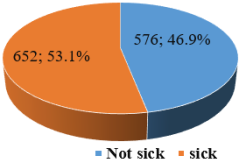
The work of Amoikon et al. (2016) showed a high prevalence of constipation and dietary deviations in a student population in Ivory coast. In order to seek a probable relationship between dietary factors and this health problem, a study was carried out at the Felix Houphouët-Boigny University of Ivory Coast. It took place from October 15, 2016 to February 17, 2017 in a population of 1228 students, with an average age of 22.5 years, dominated by males. This is a prospective cross-sectional study, with a descriptive and analytical aim, with the main objective of studying the relationship between eating habits and the appearance of constipation among students. After analysing the relationship between their eating habits and the occurrence of constipation, it was blamed, on the one hand, the high consumption of certain foods such as red meat, carbonated drinks, sugary foods, foods containing eggs or milk and on the other hand a low consumption of water, fruits and vegetables. In view of these results we can conclude that certain inadequate dietary behaviors are responsible for constipation in students’ population and could have repercussions on their success rate in our universities. To this end, it would be important to organize nutritional awareness campaigns throughout the country and to educate students with a view to improve their eating habits and their health conditions.
| Published in | Journal of Food and Nutrition Sciences (Volume 12, Issue 6) |
| DOI | 10.11648/j.jfns.20241206.13 |
| Page(s) | 270-278 |
| Creative Commons |
This is an Open Access article, distributed under the terms of the Creative Commons Attribution 4.0 International License (http://creativecommons.org/licenses/by/4.0/), which permits unrestricted use, distribution and reproduction in any medium or format, provided the original work is properly cited. |
| Copyright |
Copyright © The Author(s), 2024. Published by Science Publishing Group |
Students, Eating Habits, Constipation
Constipation | Consumption frequency N (%) | Total | P value | |||
|---|---|---|---|---|---|---|
Low | Medium | High | Very high | |||
No sick | 143 | 82 | 174b | 177 | 576 | P = 0.010 |
40.6% | 48.0% | 48.2% | 51.5% | 46.9% | ||
Sick | 209 | 89 | 187 | 167 | 652 | |
59.4% | 52.0% | 51.8% | 48.5 % | 53.1% | ||
TOTAL | 352 | 171 | 361 | 344 | 1228 | |
100% | 100% | 100% | 100% | 100% | ||
Constipation | Consumption frequency N (%) | Total | P value | |||
|---|---|---|---|---|---|---|
Low | Medium | High | Very high | |||
No sick | 15 | 30 | 51b | 479 | 576 | P = 0.010 |
42.9% | 37.5% | 44.0% | 48.1% | 46.9% | ||
Sick | 20 | 50 | 65b | 516 | 652 | |
57.1% | 62.5% | 56.0% | 51.9 % | 53.1% | ||
TOTAL | 35 | 80 | 116 | 995 | 1228 | |
100% | 100% | 100% | 100% | 100% | ||
Constipation | Consumption frequency N (%) | Total | P value | |||
|---|---|---|---|---|---|---|
Low | Medium | High | Very high | |||
No sick | 0 | 4 | 16 | 555 | 576 | P = 0.010 |
0% | 33.3% | 32.7% | 47.6% | 46.9% | ||
Sick | 0 | 8 | 33b | 611 | 652 | |
0% | 66.7% | 67.3% | 52.4 % | 53.1% | ||
TOTAL | 0 | 12 | 49 | 1166 | 1228 | |
100% | 100% | 100% | 100% | 100% | ||
Constipation | Consumption frequency N (%) | Total | P value | |||
|---|---|---|---|---|---|---|
Low | Medium | High | Very high | |||
No sick | 287 | 64 | 186 | 39 | 576 | P = 0.010 |
45.1% | 40.5% | 50.3% | 60.9% | 46.9% | ||
Sick | 349 | 94 | 184b | 25 | 652 | |
54.9% | 59.5% | 49.7% | 39.1 % | 53.1% | ||
TOTAL | 636 | 158 | 370 | 64 | 1228 | |
0% | 100% | 100% | 100% | 100% | ||
Constipation | Consumption frequency N (%) | Total | P value | |||
|---|---|---|---|---|---|---|
Low | Medium | High | Very high | |||
No sick | 117 | 0 | 112 | 347 | 576 | P = 0.001 |
56.5% | 0% | 46.7% | 44.5% | 46.9% | ||
Sick | 90 | 1 | 128 | 433 | 652 | |
43.5% | 100% | 53.3% | 55.5 % | 53.1% | ||
TOTAL | 207 | 1 | 240 | 780 | 1228 | |
100% | 100% | 100% | 100% | 100% | ||
Constipation | Consumption frequency N (%) | Total | P value | |||
|---|---|---|---|---|---|---|
Low | Medium | High | Very high | |||
No sick | 73 | 35 | 160 | 308 | 576 | P = 0.043 |
52.1% | 48.1% | 50.0% | 44.5% | 46.9% | ||
Sick | 67 | 41 | 160 | 384 | 652 | |
47.9% | 53.9% | 50.0% | 55.5 % | 53.1% | ||
TOTAL | 140 | 76 | 320 | 692 | 1228 | |
100% | 100% | 100% | 100% | 100% | ||
Constipation | Consumption frequency N (%) | Total | P value | |||
|---|---|---|---|---|---|---|
Low | Medium | High | Very high | |||
No sick | 258 | 74 | 106 | 138 | 576 | P = 0,002 |
44.3% | 43% | 46.9% | 55.9% | 46.9% | ||
Sick | 325a | 98 | 120b | 109 | 652 | |
55.7% | 57.0% | 53.1% | 44.1 % | 53.1% | ||
TOTAL | 583 | 172 | 226 | 247 | 1228 | |
100% | 100,0% | 100,0% | 100% | 100,0% | ||
Constipation | Consumption frequency N (%) | Total | P value | |||
|---|---|---|---|---|---|---|
Low | Medium | High | Very high | |||
No sick | 108 | 399 | 64 | 5 | 576 | P = 0.014 |
32.1% | 50.3% | 68.8% | 83.3% | 46.9% | ||
Sick | 228 | 394 | 29 | 1 | 652 | |
67.9% | 49.7% | 31.2% | 16.7 % | 53.1% | ||
TOTAL | 336 | 793 | 93 | 6 | 1228 | |
100% | 100% | 100% | 100% | 100% | ||
CBG | Chemistry Biology Geology |
WHO | World Health Organization |
FAO | Food and Agriculture Organization |
INS | National Institute of Public Health |
| [1] | Amoikon. K. E., Yapi A., N’Guessan. A., (2016) habitudes alimentaires liées à la survenue de la maladie hémorroïdaire chez les ivoiriens. European Scientific Journal February edition vol. 12, No. 9 ISSN: 1857 – 7881 (Print) e - ISSN 1857- 7431. |
| [2] | Dabo B. 2006. Connaissances, Attitudes et Pratiques Comportementales liées aux hémorroïdes dans le Service de Chirurgie Générale du CHU Gabriel Touré, et auprès des Thérapeutes Traditionnels. Thèse de Doctorat de Médecine, Faculté de médecine, de Pharmacie et d’Odontostomatologie, Université de Bamako, Mali; 100 p. |
| [3] |
Dembélé A. I., 2009. Etude des facteurs de risque de la maladie hémorroïdaire dans le service de médecine interne du chu du point G. Thèse de Doctorat de Médecine, Faculté de médecine, de Pharmacie et d’Odontostomatologie, Université de Bamako, Mali; 84 pages.
https://www.scirp.org/reference/referencespapers?referenceid=1921365 |
| [4] | Diallo. K., 2008. Etude épidémiologique et anatomoclinique des cancers de l’estomac à propos de 55 cas. Thèse, Med, Bamako, 2008; Thèse n°468. |
| [5] | Diarra. C. A 2009. Epidémiologie des cancers digestifs au CHU Gabriel Touré Thèse, Med, Bamako; n°479. |
| [6] | Dukan P. (2011). Dictionnaire Dukan Diététique et Nutrition. Editeur: Le cherche midi France; 480 pages. ISBN-10: 2749115329 ISBN-13: 978-2749115320. |
| [7] |
Durenne J. M, Navigué C. 2017. Les brûlures caustiques chez l’enfant africain, p1-p9.
https://fmos.usttb.edu.ml/cours/mod/resource/view.php?id=3572 |
| [8] | Institut national de statistique de Cote d’ivoire (2015): Enquête de niveau de vie P.85. |
| [9] | Kanouté. M., 2010. les cancers de l’estomac: Aspects diagnostiques et thérapeutiques dans le service de chirurgie générale du CHU Gabriel Touré. Thèse, Med, Bamako, 364. |
| [10] |
Kouakou, O. 2010. Origines sociales et comportements disciplinaires des élèves adolescents d’Abidjan. Rev. ivoir. anthropol. sociol. KASA BYA KASA, 122-131.
https://www.ijramr.com/sites/default/files/issues-pdf/2712.pdf |
| [11] |
Mohamed J. S., (2009) Complications graves de la constipation chez le patient psychiatrique. Thèse de médecine, Université Paris Diderot.
http://www.bichat-larib.com/publications.documents/4911_MOHAMED_these.pdf |
| [12] |
N’Guessan Anon F-D, ZAHE K, Y Aimé S, Digbé M Blé, Yoboué N’da M-V, AHOUA Yapi and AKE-TANO Sassor Odile Purifine (2024), Food Habits of Students At The Felix Houphouët-Boigny University of Ivory Coast, Indian Journal of Nutrition Volume 11, Issue 1 – 2024.
https://www.opensciencepublications.com/wp-content/uploads/IJN-2395-2326-11-288.pdf |
| [13] | Nancey. S, Driffa M, Sabine R, André F, Bouvier M, Claudel S, et al, (2005), L'allergie alimentaire et digestive chez l'adulte, Vol 29, N° 3 pp. 255-265. |
| [14] | OMS/FAO (2002), Régime alimentaire, nutrition et prévention des maladies chroniques. Rapport d’une consultation d’experts de l'OMS/ FAO, p 45-46. |
| [15] | Pare P., 2001. An epidemiological survey of constipation in Canada: Definitions, rates, demographics, and predictors of health care seeking. American Journal of Gastroenterology. Vol 96, P 11. |
| [16] | Sielezneff I., Antoine K., Lécuyer J., Saisse J., Thirion X., Sarles J., & Sastre B., 1998. Y a-t-il une corrélation entre les habitudes alimentaires et la maladie hémorroïdaire. Presse médicale, 27: 512-517. |
| [17] | Tzeuton C., 2000. Trouble fonctionnel digestif dans le contexte Africain Acta Endoscopica – 2000, Acta vol: 30 - n° 5 p. 155-152. |
| [18] | Yang J., Wang H. P., Zhou L., Xu C. F., 2012. Effect of dietary fiber on constipation: a meta analysis. World J Gastroenterol. Dec 28; 18(48): 7378-83. |
APA Style
N’Guessan, A. F., Aka, F. B. A., Yeboue, K. H., Ake-Tano, P. S. O., Yapi, A. (2024). Study of Relationship Between Food Habits and the Occurrence of Constipation Among Students in Ivory Coast. Journal of Food and Nutrition Sciences, 12(6), 270-278. https://doi.org/10.11648/j.jfns.20241206.13
ACS Style
N’Guessan, A. F.; Aka, F. B. A.; Yeboue, K. H.; Ake-Tano, P. S. O.; Yapi, A. Study of Relationship Between Food Habits and the Occurrence of Constipation Among Students in Ivory Coast. J. Food Nutr. Sci. 2024, 12(6), 270-278. doi: 10.11648/j.jfns.20241206.13
AMA Style
N’Guessan AF, Aka FBA, Yeboue KH, Ake-Tano PSO, Yapi A. Study of Relationship Between Food Habits and the Occurrence of Constipation Among Students in Ivory Coast. J Food Nutr Sci. 2024;12(6):270-278. doi: 10.11648/j.jfns.20241206.13
@article{10.11648/j.jfns.20241206.13,
  author = {Anon Franck-Donald N’Guessan and Francis Beranger Angelo Aka and Kouame Hermann Yeboue and Purifine Sassor Odile Ake-Tano and Ahoua Yapi},
  title = {Study of Relationship Between Food Habits and the Occurrence of Constipation Among Students in Ivory Coast
},
  journal = {Journal of Food and Nutrition Sciences},
  volume = {12},
  number = {6},
  pages = {270-278},
  doi = {10.11648/j.jfns.20241206.13},
  url = {https://doi.org/10.11648/j.jfns.20241206.13},
  eprint = {https://article.sciencepublishinggroup.com/pdf/10.11648.j.jfns.20241206.13},
  abstract = {The work of Amoikon et al. (2016) showed a high prevalence of constipation and dietary deviations in a student population in Ivory coast. In order to seek a probable relationship between dietary factors and this health problem, a study was carried out at the Felix Houphouët-Boigny University of Ivory Coast. It took place from October 15, 2016 to February 17, 2017 in a population of 1228 students, with an average age of 22.5 years, dominated by males. This is a prospective cross-sectional study, with a descriptive and analytical aim, with the main objective of studying the relationship between eating habits and the appearance of constipation among students. After analysing the relationship between their eating habits and the occurrence of constipation, it was blamed, on the one hand, the high consumption of certain foods such as red meat, carbonated drinks, sugary foods, foods containing eggs or milk and on the other hand a low consumption of water, fruits and vegetables. In view of these results we can conclude that certain inadequate dietary behaviors are responsible for constipation in students’ population and could have repercussions on their success rate in our universities. To this end, it would be important to organize nutritional awareness campaigns throughout the country and to educate students with a view to improve their eating habits and their health conditions.
},
 year = {2024}
}
TY  - JOUR
T1  - Study of Relationship Between Food Habits and the Occurrence of Constipation Among Students in Ivory Coast

AU  - Anon Franck-Donald N’Guessan
AU  - Francis Beranger Angelo Aka
AU  - Kouame Hermann Yeboue
AU  - Purifine Sassor Odile Ake-Tano
AU  - Ahoua Yapi
Y1  - 2024/11/22
PY  - 2024
N1  - https://doi.org/10.11648/j.jfns.20241206.13
DO  - 10.11648/j.jfns.20241206.13
T2  - Journal of Food and Nutrition Sciences
JF  - Journal of Food and Nutrition Sciences
JO  - Journal of Food and Nutrition Sciences
SP  - 270
EP  - 278
PB  - Science Publishing Group
SN  - 2330-7293
UR  - https://doi.org/10.11648/j.jfns.20241206.13
AB  - The work of Amoikon et al. (2016) showed a high prevalence of constipation and dietary deviations in a student population in Ivory coast. In order to seek a probable relationship between dietary factors and this health problem, a study was carried out at the Felix Houphouët-Boigny University of Ivory Coast. It took place from October 15, 2016 to February 17, 2017 in a population of 1228 students, with an average age of 22.5 years, dominated by males. This is a prospective cross-sectional study, with a descriptive and analytical aim, with the main objective of studying the relationship between eating habits and the appearance of constipation among students. After analysing the relationship between their eating habits and the occurrence of constipation, it was blamed, on the one hand, the high consumption of certain foods such as red meat, carbonated drinks, sugary foods, foods containing eggs or milk and on the other hand a low consumption of water, fruits and vegetables. In view of these results we can conclude that certain inadequate dietary behaviors are responsible for constipation in students’ population and could have repercussions on their success rate in our universities. To this end, it would be important to organize nutritional awareness campaigns throughout the country and to educate students with a view to improve their eating habits and their health conditions.

VL  - 12
IS  - 6
ER  -
Department of Nutrition, National Institute of Public Health, Abidjan, Ivory Coast
Research Fields: Food toxicology and pharmacology, nutrition and health policy, nutrition and public health care, Nutrition and no communicable diseases, nutrition and food formulation, Food security
Department of Nutrition, National Institute of Public Health, Abidjan, Ivory Coast
Research Fields: Nutrition and no communicable diseases, Interaction between food and health, Quality control of food and medicines, Human / animal nutrition and food formulation, Plants and pathology, Food toxicology, Human dietetics
Department of Biosciences, Felix Houphouet Boigny University, Abidjan, Ivory Coast
Research Fields: Nutrition and no communicable diseases, Interaction between food and health, Quality control of food, Human / animal nutrition and food formulation, Plants and pathology, Food toxicology, Human dietetics
Department of Nutrition, National Institute of Public Health, Abidjan, Ivory Coast
Research Fields: Nutrition and no communicable diseases, Nutrition and pediatric care, Nutrition policy, Human / animal nutrition and food formulation, Quality control of food and medicines, Food toxicology, Human dietetics
Department of Biosciences, Felix Houphouet Boigny University, Abidjan, Ivory Coast
Research Fields: Plants and pathology, Food toxicology Human dietetics, parasitology, Human Nutrition and Neuro Psychological pathologyAnimal Nutrition



 Share This Article
 Twitter
 Linked In
 Facebook
 Copy
Copy Download