Research Article | | Peer-Reviewed

Cocoa Residues as Alternative Support for Freeze Drying of Candida tropicalis for Controlled Fermentation of Cocoa

Received: 9 July 2024     Accepted: 2 September 2024     Published: 26 September 2024
Views:       Downloads:
Abstract

Cocoa fermentation generates significant residues, offering a valuable opportunity for sustainable utilization. In this study, these residues were evaluated as a support medium for freeze-drying Candida tropicalis, a yeast strain known to enhance the cocoa fermentation process. By integrating Candida tropicalis into fermentation, the degradation of cocoa pulp can be accelerated, improving aeration and reducing cotyledon acidity—factors that contribute to better cocoa quality. To explore this potential, cocoa pulp juice (1: 2) and cocoa pod flour were tested as support media for the freeze-drying of Candida tropicalis. The viability of the yeast post freeze-drying was assessed, with saccharose used as a control for comparison. Additionally, enzyme activity was evaluated to confirm the functional preservation of the yeast. The results showed survival rates of 72.70 ± 0.56% when cocoa pulp juice was combined with cocoa pod flour and 69.64 ± 0.52% when cocoa pulp juice was used alone. These survival rates are comparable to those achieved with saccharose, a conventional support material, indicating that cocoa residues can effectively support the freeze-drying process of Candida tropicalis. Cocoa residues thus present a cost-effective and environmentally friendly option for the freeze-drying of Candida tropicalis, with potential to enhance the overall quality of chocolate. Future research could focus on scaling up this method and optimizing conditions for larger-scale applications in the cocoa industry, further contributing to sustainable agricultural practices.

Published in Journal of Food and Nutrition Sciences (Volume 12, Issue 5)
DOI 10.11648/j.jfns.20241205.15
Page(s) 239-245
Creative Commons

This is an Open Access article, distributed under the terms of the Creative Commons Attribution 4.0 International License (http://creativecommons.org/licenses/by/4.0/), which permits unrestricted use, distribution and reproduction in any medium or format, provided the original work is properly cited.

Copyright

Copyright © The Author(s), 2024. Published by Science Publishing Group

Keywords

Support, Freeze-Drying, Yeast, Cocoa Residues

1. Introduction
Cocoa fermentation is a critical step in chocolate production, relying on the spontaneous activity of indigenous microorganisms, including yeasts, to convert the pulp into the final product . However, this process generates large quantities of by-products, such as cocoa pod shells, cocoa liquor, and cocoa bean shells, which often accumulate as waste, contributing to environmental pollution . Despite being discarded, these residues are rich in fiber, carbohydrates, lignin, proteins, and minerals, highlighting their potential for repurposing in various applications . Therefore, finding sustainable and innovative uses for cocoa residues is imperative to reduce waste and environmental impact within the cocoa industry.
One approach to improving the cocoa fermentation process is the use of lyophilized (freeze-dried) starter cultures, particularly yeasts, to control fermentation. Controlled fermentation with specific yeast strains like Candida tropicalis has been shown to enhance the quality and consistency of cocoa by optimizing pulp degradation and reducing acidity, leading to improved chocolate flavor profiles . Freeze-drying is widely recognized for its ability to preserve microbial cells for extended periods while maintaining high cell viability . However, the freeze-drying process can also cause damage to cells due to freezing and dehydration stresses, necessitating the use of protective substances, such as carbohydrates and proteins, to enhance cell survival .
While various additives like sugars, polyols, proteins, and antioxidants have been tested as protective agents during freeze-drying, the potential of cocoa residues as a support medium for preserving starter cultures remains unexplored. This presents an opportunity to investigate whether cocoa residues, which are naturally abundant in the fermentation process, could serve as an effective and eco-friendly alternative to conventional protective agents used during freeze-drying.
The aim of this study is to evaluate the potential of cocoa residues, specifically cocoa pod shells and cocoa pulp juice, as support media for the lyophilization of Candida tropicalis starter strains.
2. Material and Methods
2.1. Material
The starter yeast isolate (D5P12) used in this study was isolated from fermenting cocoa from Côte d’Ivoire . The isolate was stored at -60°C in YPG broth (1% yeast, 1% peptone, 1% glucose) with added glycerol in the Laboratory.
2.2. Methods
2.2.1. Molecular Identification of the Yeast Isolate (D5P12)
The method consisted of amplifying by PCR and sequencing D1/D2 domain of 5.8 S rDNA.
(i). Extraction of Yeast Genomic DNA
The extraction of the yeast genomic DNA was done using the phenol/chloroform method by Hoffman with modifications. An isolated yeast colony was used to inoculate 2 mL of YPG culture medium (1% peptone, 1% yeast extract, and 2% glucose). The cell culture was incubated at 30 °C for 48 h with shaking at 180 rpm. The cultures were then transferred into screw-cap Eppendorf tubes, and the cell culture was subsequently centrifuged at 13,000 rpm for 1 min. The cell pellet was resuspended in 500 µL of distilled water, and the cell suspension was centrifuged for 1 minute at 13,000 rpm. A quantity of 0.3 g of glass microbeads was added to the cell pellet with 200 µL of lysis buffer (2% triton X-100, 1% SDS, 100 mM NaCl, 10 mM Tris-HCl (pH 8), 1 mM EDTA (pH 8)) and 200 µL of phenol/chloroform/isoamyl alcohol pH 6.7 - 8 (25/24/1) mixture under a fume hood. The mixture was then vortexed (Vortex Genie-2, USA) for 5 minutes at maximum agitation. Then, 200 µL of 1X TE (10 mM Tris HCl pH 8; 1 mM EDTA (pH 8)) was added, and the mixture was vortexed as previously described. The resulting suspension was centrifuged for 5 min at 13,000 rpm, and the supernatant was collected in an Eppendorf tube. To this supernatant, 400 µL of chloroform was added. The resulting mixture was vortexed for 1 minute and then centrifuged for 3 minutes at 13,000 rpm. The supernatant from the mixture was collected in an Eppendorf tube and treated with RNase A (Eurodemex) to eliminate any RNAs that might contaminate the extracted DNA. For this, the reaction medium was made up of 400 µL of the supernatant and 4 µL of RNase A. This medium was incubated for 10 minutes at 37 °C. After incubation, the DNA was precipitated by adding 40 µL of 3 M sodium acetate pH 5.2 (to reduce the DNA’s polarity) and 1 mL of absolute ethanol to the mixture. The mixture was homogenized by inversion (5 to 15 min) and then centrifuged for 1 minute at 13,000 rpm. The resulting DNA pellet was washed by adding 500 µL of 70% (v/v) ethanol to the DNA pellet and then centrifuged for 2 minutes at 13,000 rpm. The washed DNA pellet was dried in a speedvac at 37 °C for 1 hour and subsequently dissolved in 100 µL of DNA-free miliQ water.
(ii). Analysis of the D1/D2 Domain Sequence of the 26 S rDNA Gene and Genetic Characterization of D5P12 Isolate
The domain was amplified with primers NL1 (5’CGCCCGCCGCGCGCGGCGGGCGGGGCGGGGGCCATATCAATAAGCGGAGGAAAAG3’) and LS2 (5’ATTCCCAAACAACTCGACTC 3’, Sigma) by the method of Hamdouche et al. . The reaction mixture for PCR extraction was constituted of 0,25 µL of each primer (0, 2 µM), 8,5 µL of milliQ water and 10 µL of master mix (ozone) and the following PCR amplification program was used starting with an initial denaturation at 94º C for 2 minutes; 30 cycles of: denaturation at 94º C for 20 seconds, primer annealing at 50ºC for 20 seconds, and extension at 72ºC for 30 seconds for DNA strand elongation; a final extension at 72ºC for 2 minutes. The obtained PCR amplification products were purified using QIAGEN Kit and sequenced by MICROSYNTH FRANCE SAS of Claude Bernard University, Lyon.
The sequences obtained were used to probe the NCBI database to determine the identity of the yeast isolate.
2.2.2. Preparation of Different Support Material for Lyophilization
(i). Preparation of Cocoa Pod Flour
The cocoa pods were obtained from the District of Agboville located in the southern part of Côte d’Ivoire, 79 km from the capital city, Abidjan. Once obtained the seeds were removed from the pod and cut into pieces. The cut pods were then dried in the oven at 50°C for 48 h and mixed using a blender. The powder was stored in a flask for further studies.
(ii). Preparation of Cocoa Pulp Juice Extract
The cocoa pulp juice extract was prepared in two proportions 1:1 and 1:2. The different proportions were prepared by diluting 1 kg of fresh cocoa seeds in 1 litre and 500 mL of distilled water respectively. The cocoa pulp juice extracts were sterilized and stored in flasks for further studies.
(iii). Culture of the Yeast Isolate
The yeast isolate was revived in YPG broth (1% yeast, 1% peptone, 1% glucose) for 24h. They were then replicated on YEPG agar plates. The starter isolate was incubated at 30°C for 48h. A pure colony was used to prepare a dense suspension with 120ml of YPG broth. The cultures were incubated at 30°C for 3 days in an oven.
2.2.3. Lyophilisation of the Yeast Isolate
The yeast culture prepared above was centrifuged at 12000 x g for 5 min at 4°C in a refrigerated centrifuge (Laboao, China). The pellets were rinsed two times with 0.9% of sodium chloride (NaCl) and collected. Cocoa pod flour was prepared to obtain a final concentration of 4%. For that an amount of 2 g of cocoa pod flour were dissolved in 50 ml of distilled water. The mixture was heated to obtain a final temperature of 70-80°C for a period of 20-30 min while stirring. The mixture was allowed to cool to reach a temperature of 30-40°C . Different combinations of the isolate with the pulp juice/ cocoa pod flour were used. All the compositions prepared were listed in the table 1 bellow. Finally, the mixtures were kept in the freezer at -60°C for 6-24 hours and lyophilized for 36 hours at atmospheric pressure of 1 Pa and a temperature of -45°C using a benchtop Normal Lab freeze-dryer (Laboao, China).
Table 1. Index of the different formulation compositions of support material.

Essay

Cocoa pod flour (ml)

Pulp juice 1:1 (ml)

Pulp juice 1:2 (ml)

Physiological saline (ml)

Saccharose (ml)

1

2.5

0

0

22.5

0

2

0

25

0

0

0

3

0

0

25

0

0

4

2.5

22.5

0

0

0

5

2.5

0

22.5

0

0

6

0

0

0

20

5

2.2.4. Determination of Survival Rate of the Yeast Isolate After Lyophilization
Serial dilutions’ method described by was used to determine the survival rate of the yeast isolate onto YPG agar plates in microbial culture made in 2.2.1. After the lyophilization process, 0.1 g of freeze-dried bacterial powder was diluted in a volume of 4 ml of physiological saline for each composition of mixture. The samples were incubated at 30°C for 2 h. Then, serial dilutions of each sample incubated were prepared and a volume of the cell suspension was inoculated onto the YPG agar plate uniformly. The plates were kept at 30°C for 48 h. Cell viability was determined using a standard count method on YPG agar medium. The dilution times and the corresponding number of yeasts were recorded. The average of the three plates was used for the number of yeasts per dilution, in which the plate with a yeast count of 30–300 CFU and no spreading colony growth was selected. The survival rate of the yeast isolate after freeze-drying process was expressed according to the method of Mendoza et al. . Cell viability obtained for each (essay) was expressed as Survival Factor (SF) in percentage, calculated using the following equation:
SF=1-(logCFUbefore-logCFUafter)logCFUbeforeX100
Where:
CFUbefore = CFUml-1 𝖷 total volume culture (ml) before the freeze – drying process
CFUafter = CFUg-1 𝖷 total weight of the dry bacterial sample (g)
2.2.5. Determination of Pectinolytic Activity of the Yeast Isolate
The pectinolytic activity of the yeast isolate was assessed before and after freeze-drying using a modified version of the method described by Ouattara et al. . The medium used, YNB-PGA, consisted of 7 g/L of yeast nitrogen base (YNB), 5 g/L of polygalacturonic acid (PGA), and 20 g/L of agar, adjusted to pH 5. Sterile holes with a diameter of 0.5 cm and a depth of 2 mm were created on the agar surface using the sleeve of a Pasteur pipette. A cell suspension of the isolates to be tested was prepared in tryptone salt, and the cell concentration was adjusted to 105 cell/mL using Thomas cell and methylene blue method. The appropriate volume of the cell suspension was used to inoculate the wells created in the agar. The cultures were then incubated at 30°C for 48 hours. After incubation, the pectinolytic enzyme production was visualized by flooding the agar surface with an iodine and potassium iodide solution (5 g potassium iodide + 1 g iodine + 330 mL distilled water). The clear zones around the colonies were measured using a ruler, and the relative enzyme production (%) was calculated.
2.2.6. Evaluation of the Conservation of Candida tropicalis Lyophilizate at Ambient Temperature
After lyophilization of the Candida tropicalis lyophilizate in the presence of a 1:2 mixture of cocoa pulp juice and cocoa pod flour, the samples that showed the highest survival rate were stored in a room at ambient temperature. Every week, the viable cell count, and relative survival rate were calculated, as described in section 2.2.4.
2.2.7. Statistical Analysis
All experiments were done in triplicates and the raw data generated were presented as mean ± standard deviation. A one-factor analysis of variance (ANOVA) was used to compare the means. Means were separated by Tukey's error rate multiple comparison test using XLSTAT. The differences in means were considered statistically significant at p < 0.05.
3. Results
3.1. Molecular Identification of Yeast Isolate (D5P12)
The blast analysis of domain D1/D2 of 5,8 S rDNA of yeast D5P12 revealed that the yeast isolate D2P12 was Candida tropicalis with 100 % homologous with those of the data base.
3.2. Determination of Survival Rate of Candida tropicalis After Freeze Drying
Table 2 shows the survival rate of Candida tropicalis in presence of different support material (saccharose, cocoa pod flour, cocoa pod flour and cocoa pulp juice in proportions 1:2 or 1:1). The survival rates obtained were comprised between 44.45 ± 0.22 and 73.73 ± 4.55%. The combination of support containing cocoa pulp juice in ½ proportion and cocoa pod powder gave the highest levels 72.70 ± 0.56 close to that of the saccharose (73.73 ± 4.55). While with cocoa powder, cocoa pulp juice in ½ proportion and cocoa powder added to cocoa pulp juice in 1/1 proportion, the survival rates of the strains were lower than those obtained with saccharose but all higher and close to 60%.
Table 2. Survival rate of Candida tropicalis in different support material and cryoprotectant after freeze-drying.

Support material / cryoprotectant

Survival rate (%)

Cocoa pulp juice 1:1

44.45 ± 0.22a

Cocoa pod flour

61.16 ± 0.31b

Cocoa pulp juice 1:1/cocoa pod flour

64.74 ± 0.54c

Cocoa pulp juice 1:2

69.64 ± 0.52d

Cocoa pulp juice 1:2/Cocoa pod flour

72.70 ± 0.56de

Saccharose

73.73 ± 4.55e

Values presented in the table are expressed as mean±SD.
a, b, c, d, e = significantly different (p<0.05)
3.3. Determination of Enzyme Production of Candida tropicalis After Freeze Drying
Pectinolytic enzyme plays an important role during cocoa fermentation. After freeze drying of cocoa starter, their ability to produce this enzyme must be evaluated. These results are presented in Table 3. Indeed, in the absence of a support material, the strain of Candida tropicalis loses more than 52% of its pectinolytic enzyme production capacity. However, in the presence of cocoa pulp juice 1:2 proportion and cocoa pod flour, the Candida tropicalis strain retains more than 85% of its pectinolytic enzyme production capacity, unlike saccharose, which has a rate of 70%.
Table 3. Enzyme production of Candida tropicalis after freeze drying in solid media.

Support material

Relative enzyme production (%)

Candida tropicalis

48.76 ± 3.85a

Cocoa pulp juice 1:1/cocoa pod flour

64.81 ± 3.20b

Cocoa pod flour

66.66 ± 0.00b

Saccharose

70.37 ± 6.41b

Cocoa pulp juice 1:1

79.63 ± 3.20c

Cocoa pulp juice 1:2/cocoa pod flour

85.18 ± 6.41cd

Cocoa pulp juice 1:2

88.88 ± 5.55d

Values are presented as mean ± SD.
a, b, c, d = significantly different (p<0.05)
3.4. Conservation of the Candida tropicalis Lyophilizate Obtained with Cocoa Pulp Juice ½ and Cocoa Pod Flour
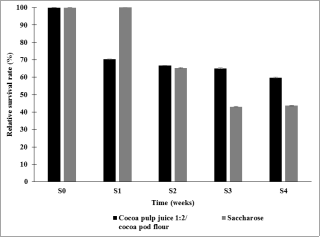
The strain of Candida tropicalis maintains its survival level after a week of conservation at room temperature in the presence of saccharose as a cryoprotectant. On the other hand, during this same period in the presence of cocoa pulp juice extract and cocoa pod flour, the strain loses 30% of its survival rate. However, during conservation, the cocoa pulp juice and cocoa pod flour maintain their survival rate even more after two weeks of conservation, with rates ranging around 60%, as opposed to 40% for the saccharose control.
Figure 1. Relative survival rate of Candida tropicalis lyophilizate at ambient temperature over time.
4. Discussion
The primary objective of the study was to identify alternative support materials for freeze-drying Candida tropicalis. Freeze-drying is a widely used method for the long-term preservation of microorganisms, combining freezing and drying to produce a high-quality final dried product . However, during the freezing step, ice crystals can form, causing mechanical damage and cell death . Microbial survival depends on various factors such as initial microorganism concentration, strain resistance traits, drying medium, and growth conditions . Protective agents typically contain amino or hydroxyl groups that can replace water on macromolecules, protecting proteins and lipid membranes during storage and enhancing cell recovery . Therefore, support materials play a crucial role in freeze-drying . The study found that cocoa pod husk and cocoa pulp juice were effective in maintaining Candida tropicalis viability after freeze-drying, with a survival rate of 72.70% for the combination of cocoa pod husk and 1:2 cocoa pulp juice, similar to saccharose control. The results obtained are in accordance with those of Liming et al. who obtained rate of 73% when 15% sucrose was used as cryoprotectants for Candida tropicalis.
The chemical composition of cocoa pod husk is mainly fiber, carbohydrates, lignin, proteins, and minerals . While cocoa pulp juice is rich in sugars such as glucose, fructose, and saccharose . Commonly used support materials are compounds like disaccharides, monosaccharides, polyols, amino acids, and other organic molecules . Which may explain why cocoa pod husk or cocoa pulp juice were effective in freeze-drying.
Combining support materials can enhance their protective effect, as seen in this study where the survival rates were higher with the combination of cocoa pod husk and cocoa pulp juice 1:2 compared to when they were used alone. This is in line with previous research showing that using a combination of protectant agents can overcome the drawbacks of individual support materials, hence improving overall performance .
Yeasts are also known for producing pectinolytic enzymes, especially polygalacturonase-producing strains like Candida tropicalis, which play an important role in the cocoa fermentation process. Consequently, the starters intended for controlling the fermentation process need to have a high level of this enzyme's production after freeze-drying. Therefore, we also evaluated the enzyme production levels of the lyophilizates after freeze-drying. In this study, the method used for detecting enzyme activity indicated clear halos around colonies in all the holes, indicating pectin or polygalacturonic acid degradation according to . The results obtained show that relative enzyme production differs depending on the type of support material used. Indeed, the relative pectinolytic enzyme production with the lyophilized strain without support material was less than 50%. This suggests that lyophilization could impact the genetic mechanism of pectinolytic enzyme production in the yeast Candida tropicalis. Additionally, while some authors like Kandil et al. have shown that lyophilization reduces the production of aminopeptidase and esterase activity in lactic acid bacteria strains, certain species are insensitive to lyophilization in terms of enzyme production . On the other hand, the lyophilization the support material composed of a 1:2 mixture of cocoa pulp juice and cocoa pod flour, with a relative enzyme production level of more than 80%, considerably reduces the negative effect of freeze-drying on pectinolytic enzyme production compared to the cryoprotectant saccharose that is generally used for the lyophilization of yeasts. This could be linked to the presence of various protective molecules contained in cocoa pulp juice and cocoa pod flour, such as glucose, fructose, and saccharose.
Furthermore, our results show that the support material consisting of a 1:2 mixture of cocoa pulp juice and cocoa pod flour maintains the Candida tropicalis starter was viable with a survival rate of over 60% after 1 month of conservation compared to the saccharose control. Such a result is interesting because starters produced with cocoa residues would be much cheaper, and the storage conditions for these starters would be much less constraining for farmers.
5. Conclusions
In this study, we conducted freeze drying using cocoa residues (cocoa pulp juice and cocoa pod flour) and observed that Candida tropicalis behaves differently depending on the type of support material used. The combination of cocoa pulp juice 1:2 with cocoa pod flour yielded the best results in terms of survival rate and enzyme production after freeze drying. Cocoa residues could serve as a potential alternative for freeze drying Candida tropicalis. This will hep solve pollution concerns and hence contribute to circular economy of the industry. In the future, the freeze-dried powder could be utilized in fermentation trials.
Abbreviations

YPG

Yeast, Peptone, Glucose

PCR

Polymerase Chain Reaction

YEPG

Yeast, Ethanol, Peptone, Glucose

NaCl

Sodium Chloride

Author Contributions
Victoria Kadet: Conceptualization, Data curation, Formal Analysis, Methodology, Writing – original draft, Writing – review & editing
Lamine Samagaci: Supervision, Conceptualization, Methodology, Validation, Writing – review & editing
Hadja Ouattara: Supervision, Writing – review & editing
Jean-Marie Ahoussi: Methodology, Data curation
Yannick Ettien: Methodology, Software
Honoré Ouattara: Software, Supervision
Marc Lemaire: Data curation, Methodology, Resources, Software, Writing – review & editing
Sébastien Niamké: Supervision, Validation, Visualization, Writing – review & editing
Conflicts of Interest
The authors declare no conflicts of interest.
References
[1] Lima CO, Vaz AB, De Castro GM, Lobo F, Solar R, Rodrigues C, et al. Integrating microbial metagenomics and physicochemical parameters and a new perspective on starter culture for fine cocoa fermentation. Food microbiology. 2021, 93, 103608.
[2] Ramos LH, Cisneros-Yupanqui M, Santisteban Soto DV, Lante A, Favaro L, Casella S, et al. Exploitation of Cocoa Pod Residues for the Production of Antioxidants, Polyhydroxyalkanoates, and Ethanol. Fermentation. 2023, 9(9), 843.
[3] Indiarto R, Raihani Z, Dewi M, Zsahra A. A review of innovation in cocoa bean processing by-products. Int J. 2021, 9, 1162-9.
[4] Valladares-Diestra KK, de Souza Vandenberghe LP, Soccol CR. A biorefinery approach for pectin extraction and second-generation bioethanol production from cocoa pod husk. Bioresource technology. 2022, 346, 126635.
[5] Díaz-Muñoz C, De Vuyst L. Functional yeast starter cultures for cocoa fermentation. Journal of Applied Microbiology. 2022, 133(1), 39-66.
[6] Marcial-Coba MS, Knøchel S, Nielsen DS. Low-moisture food matrices as probiotic carriers. FEMS microbiology letters. 2019, 366(2), fnz006.
[7] Kandylis P, Dimitrellou D, Lymnaiou P, Koutinas AA. Freeze-dried Saccharomyces cerevisiae cells immobilized on potato pieces for low-temperature winemaking. Applied biochemistry and biotechnology. 2014, 173, 716-30.
[8] Wang F, Xiong S, Li X, Yu J, Huang Y, Liu Y. Cryoprotective effect of silver carp muscle hydrolysate on baker's yeast Saccharomyces cerevisiae and its underlying mechanism. Food Science & Nutrition. 2020, 8(1), 190-8.
[9] Samagaci L. Identification de la flore microbienne impliquée dans la fermentation du cacao ivoirien et détermination du rôle des microorganismes identifiés dans la perspective de maîtriser et de standardiser le processus fermentaire grâce à des souches microbiennes sélectionnées de type starters Ph. D. Thesis, Université Felix Houphouet-Boigny, Côte d'Ivoire, 2017.
[10] Hoffman CS. Preparation of yeast DNA. Current protocols in molecular biology. 1997, 39(1), 13-1.
[11] Hamdouche Y, Guehi T, Durand N, Kedjebo KBD, Montet D, Meile JC. Dynamics of microbial ecology during cocoa fermentation and drying: Towards the identification of molecular markers. Food control. 2015, 48, 117-22.
[12] Coulibaly HW. Mise en place d'un starter lyophilisé pour la fermentation alcoolique de la biere de sorgho. Ph.D. Thesis, Université Nangui Abrogoua, Côte d'Ivoire, 2016.
[13] Cui S, Hu M, Sun Y, Mao B, Zhang Q, Zhao J, et al. Effect of Trehalose and Lactose Treatments on the Freeze-Drying Resistance of Lactic Acid Bacteria in High-Density Culture. Microorganisms. 2022, 11(1), 48.
[14] Mendoza GM, Pasteris SE, Otero MC, Nader-Macias FME. Survival and beneficial properties of lactic acid bacteria from raniculture subjected to freeze-drying and storage. Journal of Applied Microbiology. 2013, 116, 157-66.
[15] Ouattara HG, Koffi BL, Karou GT, Sangaré A, Niamke SL, Diopoh JK. Implication of Bacillus sp. in the production of pectinolytic enzymes during cocoa fermentation. World Journal of Microbiology and Biotechnology. 2008, 24, 1753-60.
[16] Martín MJ, Lara-Villoslada F, Ruiz MA, Morales ME. Microencapsulation of bacteria: A review of different technologies and their impact on the probiotic effects. Innovative Food Science & Emerging Technologies. 2015, 27, 15-25.
[17] Tymczyszyn EE, Gómez-Zavaglia A, Disalvo EA. Influence of the growth at high osmolality on the lipid composition, water permeability and osmotic response of Lactobacillus bulgaricus. Archives of biochemistry and biophysics. 2005, 443(1-2), 66-73.
[18] Morgan CA, Herman N, White P, Vesey G. Preservation of micro-organisms by drying; a review. Journal of microbiological methods. 2006, 66(2), 183-93.
[19] López-Martínez G, Rodríguez-Porrata B, Margalef-Català M, Cordero-Otero R. The STF2p hydrophilin from Saccharomyces cerevisiae is required for dehydration stress tolerance. PLoS One. 2012, 7(3), e33324.
[20] Santivarangkna C, Higl B, Foerst P. Protection mechanisms of sugars during different stages of preparation process of dried lactic acid starter cultures. Food microbiology. 2008, 25(3), 429-41.
[21] Celik O, O’Sullivan D. Factors influencing the stability of freeze-dried stress-resilient and stress-sensitive strains of bifidobacteria. Journal of dairy science. 2013, 96(6), 3506-16.
[22] Liming M, Masniyom P, Maneesri J. Effects of freeze drying on cell viability of Candida tropicalis and Lactobacillus plantarum starter culture. In proceeding of The 16th Food Innovation Asia conference, 2014; 39
[23] de Souza Vandenberghe LP, Valladares-Diestra KK, Bittencourt GA, de Mello AFM, Vásquez ZS, de Oliveira PZ, et al. Added-value biomolecules’ production from cocoa pod husks: A review. Bioresource technology. 2022, 344, 126252.
[24] Bickel Haase T, Schweiggert-Weisz U, Ortner E, Zorn H, Naumann S. Aroma properties of cocoa fruit pulp from different origins. Molecules. 2021, 26(24), 7618.
[25] Bravo-Ferrada BM, Brizuela N, Gerbino E, Gómez-Zavaglia A, Semorile L, Tymczyszyn EE. Effect of protective agents and previous acclimation on ethanol resistance of frozen and freeze-dried Lactobacillus plantarum strains. Cryobiology. 2015, 71(3), 522-8.
[26] Rajan R, Matsumura K. Development and application of cryoprotectants. Advances in Experimental Medicine and Biology. 2018, 1081, 339-54.
[27] Chanyuan Y, Xiaoli Z, Daidi F, Yu M, Yan'e L, Junfeng H, et al. Optimizing the chemical compositions of protective agents for freeze-drying Bifidobacterium longum BIOMA 5920. Chinese Journal of Chemical Engineering. 2012, 20(5), 930-6.
[28] Padma PN, Anuradha K, Reddy G. Pectinolytic yeast isolates for cold-active polygalacturonase production. Innovative Food Science & Emerging Technologies. 2011, 12(2), 178-81.
[29] Kandil S, El Soda M. Influence of freezing and freeze drying on intracellular enzymatic activity and autolytic properties of some lactic acid bacterial strains. Advances in Microbiology. 2015, 5(6), 371-82.
[30] Sundari SK, Adholeya A. Retention of enzyme activity following freeze-drying the mycelium of ectomycorrhizal isolates: part II. Enzymes acting upon carbon compounds. World Journal of Microbiology and Biotechnology. 2000, 16, 865-8.
[31] Grzegorczyk M, Kancelista A, Łaba W, Piegza M, Witkowska D. The effect of lyophilization and storage time on the survival rate and hydrolytic activity of Trichoderma strains. Folia microbiologica. 2018, 63, 433-41.
[32] Bruin S, Luyben KCA. Drying of food materials: a review of recent developments. In 1st International Drying Symposium, Montreal, Canada, 1978; pp. 1.
[33] Yamamoto S, Fujii S, Mako M, Yoshimoto N. Effect of sugars and polyols on the inactivation of yeasts during drying. In Proceedings of 16th International Drying Symposium, Hyderabad, India, 2008; 1751-4.
Cite This Article
  • APA Style

    Kadet, V., Samagaci, L., Ouattara, H., Ahoussi, J., Ettien, Y., et al. (2024). Cocoa Residues as Alternative Support for Freeze Drying of Candida tropicalis for Controlled Fermentation of Cocoa. Journal of Food and Nutrition Sciences, 12(5), 239-245. https://doi.org/10.11648/j.jfns.20241205.15

    Copy | Download

    ACS Style

    Kadet, V.; Samagaci, L.; Ouattara, H.; Ahoussi, J.; Ettien, Y., et al. Cocoa Residues as Alternative Support for Freeze Drying of Candida tropicalis for Controlled Fermentation of Cocoa. J. Food Nutr. Sci. 2024, 12(5), 239-245. doi: 10.11648/j.jfns.20241205.15

    Copy | Download

    AMA Style

    Kadet V, Samagaci L, Ouattara H, Ahoussi J, Ettien Y, et al. Cocoa Residues as Alternative Support for Freeze Drying of Candida tropicalis for Controlled Fermentation of Cocoa. J Food Nutr Sci. 2024;12(5):239-245. doi: 10.11648/j.jfns.20241205.15

    Copy | Download

  • @article{10.11648/j.jfns.20241205.15,
      author = {Victoria Kadet and Lamine Samagaci and Hadja Ouattara and Jean-Marie Ahoussi and Yannick Ettien and Honoré Ouattara and Marc Lemaire and Sébastien Niamké},
      title = {Cocoa Residues as Alternative Support for Freeze Drying of Candida tropicalis for Controlled Fermentation of Cocoa
    },
      journal = {Journal of Food and Nutrition Sciences},
      volume = {12},
      number = {5},
      pages = {239-245},
      doi = {10.11648/j.jfns.20241205.15},
      url = {https://doi.org/10.11648/j.jfns.20241205.15},
      eprint = {https://article.sciencepublishinggroup.com/pdf/10.11648.j.jfns.20241205.15},
      abstract = {Cocoa fermentation generates significant residues, offering a valuable opportunity for sustainable utilization. In this study, these residues were evaluated as a support medium for freeze-drying Candida tropicalis, a yeast strain known to enhance the cocoa fermentation process. By integrating Candida tropicalis into fermentation, the degradation of cocoa pulp can be accelerated, improving aeration and reducing cotyledon acidity—factors that contribute to better cocoa quality. To explore this potential, cocoa pulp juice (1: 2) and cocoa pod flour were tested as support media for the freeze-drying of Candida tropicalis. The viability of the yeast post freeze-drying was assessed, with saccharose used as a control for comparison. Additionally, enzyme activity was evaluated to confirm the functional preservation of the yeast. The results showed survival rates of 72.70 ± 0.56% when cocoa pulp juice was combined with cocoa pod flour and 69.64 ± 0.52% when cocoa pulp juice was used alone. These survival rates are comparable to those achieved with saccharose, a conventional support material, indicating that cocoa residues can effectively support the freeze-drying process of Candida tropicalis. Cocoa residues thus present a cost-effective and environmentally friendly option for the freeze-drying of Candida tropicalis, with potential to enhance the overall quality of chocolate. Future research could focus on scaling up this method and optimizing conditions for larger-scale applications in the cocoa industry, further contributing to sustainable agricultural practices.
    },
     year = {2024}
    }
    

    Copy | Download

  • TY  - JOUR
    T1  - Cocoa Residues as Alternative Support for Freeze Drying of Candida tropicalis for Controlled Fermentation of Cocoa
    
    AU  - Victoria Kadet
    AU  - Lamine Samagaci
    AU  - Hadja Ouattara
    AU  - Jean-Marie Ahoussi
    AU  - Yannick Ettien
    AU  - Honoré Ouattara
    AU  - Marc Lemaire
    AU  - Sébastien Niamké
    Y1  - 2024/09/26
    PY  - 2024
    N1  - https://doi.org/10.11648/j.jfns.20241205.15
    DO  - 10.11648/j.jfns.20241205.15
    T2  - Journal of Food and Nutrition Sciences
    JF  - Journal of Food and Nutrition Sciences
    JO  - Journal of Food and Nutrition Sciences
    SP  - 239
    EP  - 245
    PB  - Science Publishing Group
    SN  - 2330-7293
    UR  - https://doi.org/10.11648/j.jfns.20241205.15
    AB  - Cocoa fermentation generates significant residues, offering a valuable opportunity for sustainable utilization. In this study, these residues were evaluated as a support medium for freeze-drying Candida tropicalis, a yeast strain known to enhance the cocoa fermentation process. By integrating Candida tropicalis into fermentation, the degradation of cocoa pulp can be accelerated, improving aeration and reducing cotyledon acidity—factors that contribute to better cocoa quality. To explore this potential, cocoa pulp juice (1: 2) and cocoa pod flour were tested as support media for the freeze-drying of Candida tropicalis. The viability of the yeast post freeze-drying was assessed, with saccharose used as a control for comparison. Additionally, enzyme activity was evaluated to confirm the functional preservation of the yeast. The results showed survival rates of 72.70 ± 0.56% when cocoa pulp juice was combined with cocoa pod flour and 69.64 ± 0.52% when cocoa pulp juice was used alone. These survival rates are comparable to those achieved with saccharose, a conventional support material, indicating that cocoa residues can effectively support the freeze-drying process of Candida tropicalis. Cocoa residues thus present a cost-effective and environmentally friendly option for the freeze-drying of Candida tropicalis, with potential to enhance the overall quality of chocolate. Future research could focus on scaling up this method and optimizing conditions for larger-scale applications in the cocoa industry, further contributing to sustainable agricultural practices.
    
    VL  - 12
    IS  - 5
    ER  - 

    Copy | Download

Author Information
  • Biotechnology Laboratory, UFR Biosciences, Félix Houphouët-Boigny University, Abidjan, Côte d'Ivoire


  • Biotechnology Laboratory, UFR Biosciences, Félix Houphouët-Boigny University, Abidjan, Côte d'Ivoire

  • Biotechnology Laboratory, UFR Biosciences, Félix Houphouët-Boigny University, Abidjan, Côte d'Ivoire

  • Biotechnology Laboratory, UFR Biosciences, Félix Houphouët-Boigny University, Abidjan, Côte d'Ivoire

  • Biotechnology Laboratory, UFR Biosciences, Félix Houphouët-Boigny University, Abidjan, Côte d'Ivoire

  • Biotechnology Laboratory, UFR Biosciences, Félix Houphouët-Boigny University, Abidjan, Côte d'Ivoire

  • Microorganism, Pathogeny and Adaptation Laboratory, Claude Bernard of Lyon University, Lyon, France

  • Biotechnology Laboratory, UFR Biosciences, Félix Houphouët-Boigny University, Abidjan, Côte d'Ivoire

  • Abstract
  • Keywords
  • Document Sections

    1. 1. Introduction
    2. 2. Material and Methods
    3. 3. Results
    4. 4. Discussion
    5. 5. Conclusions
    Show Full Outline
  • Abbreviations
  • Author Contributions
  • Conflicts of Interest
  • References
  • Cite This Article
  • Author Information