Research Article | | Peer-Reviewed

Zonal Effect on the Essential Oil Profile from Cymbopogon citratus (Lemongrass) Leaves and Citrus sinensis (Orange) Peels harvesting in Mali

Received: 20 September 2024     Accepted: 12 October 2024     Published: 31 October 2024
Views:       Downloads:
Abstract

Nowadays, Cymbopogon citratus (DC.) Staph (Poaceae), (Lemongrass) and Citrus sinensis (L.) Osbeck (Rutaceae), (orange) are very coveted for aromatic, food and medicinal purposes. Lemongrass leaves and orange zests are reputed to be rich in essential oils, which are highly prized by the food industry. The aim of this study was to determine the essential oil (EOs) extraction yields and their profile of these species collected in three agro-ecological zones of Mali. EOs were extracted by steam distillation and their profile was determined by thin layer chromatography (TLC) and gas chromatography-mass spectrometry (GC-MS). All registered data revealed zonal variation of extraction yields as well as in EO components (p-value < 0.05). Extraction yields varied from 0.32±0.02 to 0.44±0.03% for lemongrass and 0.32±0.01 to 0.50±0.03 for orange. These yields were higher in Sahelian zones for both species. Moreover, chromatography technique highlighted an important diversity of lemongrass and orange peel in individual EO components. Thus, Retention factors values recorded from TLC allowed to detect a maximum of different EO individuals: 15 for lemongrass and 13 for orange, mainly in Sahelian. Similarly with GC technique, more EO elements were found: a total of 23 for orange zests samples and 17 for lemongrass. Samples collected in Sudano-guinean sites presented the highest number of total individual EO constituents, 16 for orange and 12 for lemongrass. The major individual EO components were Limonene (43.14±0.20%), Neral (36.00±0.14%), and M-Camphorene (19.88±0.17%) for leaves of lemongrass, and carvone (19.59±0.58%), Citral (17.99±0.01%), and Neral (17.48±0.10%) for orange zests. This richness and diversity could be useful to better valorization of lemongrass leaves and orange peel in Mali.

Published in Journal of Food and Nutrition Sciences (Volume 12, Issue 5)
DOI 10.11648/j.jfns.20241205.16
Page(s) 246-254
Creative Commons

This is an Open Access article, distributed under the terms of the Creative Commons Attribution 4.0 International License (http://creativecommons.org/licenses/by/4.0/), which permits unrestricted use, distribution and reproduction in any medium or format, provided the original work is properly cited.

Copyright

Copyright © The Author(s), 2024. Published by Science Publishing Group

Keywords

Cymbopogon citratus, Citrus sinensis, Essential Oils, Yield, Composition, Zones, Mali

1. Introduction
Cymbopogon citratus (DC.) Stapf (Poaceae), (Lemongrass) commonly known as Indian verbena or lemongrass, is a member of the Poaceae (grass) family. As a herbaceous plant with long, blue-green leaves, it is found in tropical and semi-tropical regions of Asia, South and Central America and Africa, as well as in all tropical countries . C. citratus leaves are the most coveted part used as an infusion, decoction or maceration due their nutritional and therapeutics needs. Recipes made from Lemongrass leaves are reputed to manage number diseases such as coughs, elephantiasis, flu, gingivitis, headaches, stomachaches, leprosy, malaria, ophthalmic, pneumonia, and metabolic disorders . In addition, species is also used as a natural cleaner that aids in many organs’ detoxification of human being (liver, pancreas, kidneys, bladder, and digestive tract). Its ability to decrease the levels of uric acid, cholesterol, blood pressure, excess lipids, and other toxins in the human body was reported .
Citrus sinensis (L.) Osbeck (Rutaceae) or sweet orange belonging to the Rutaceae family, is widely cultivated in tropical and subtropical zones . The fruit of citrus of very prized in addition to its juice, while peels removed from the fruit are discarded in the environment. The literature estimates that each year, about 50% of orange residues (peel) are being generated from the citrus-processing industries , which are either used as animal feed. Most part of these peels (zests) are improperly disposed in the nature, and consequently may cause environmental pollution .
Studies reported the richness of Lemongrass leaves and orange zests in essential oils (EOs), which can be a major pool of different food-value added products. Because EOs are highly coveted due their involvement in the treatment of many diseases and to their aromatic and nutritional purposes. For instance, EOs are endowed with antibacterial, antiparasitic, antifungal, anti-insecticidal properties .
EOs with insecticidal properties have been used to kill insects all over the world since ancient times. Due to their low toxicity to warm-blooded mammals and to their high volatility, these plant components are considered to be an alternative to conventional pesticides . In addition, they are found to be safer for the environment than synthetic insecticides with many side effects . Furthermore, Thanks to their safety category and exemption from mammalian toxicity by the United States Food and Drug Administration, EOs constituents open a novel eco-friendly approach toward food protection . Despite these advantages of the EOs contained in lemongrass leaves and orange zests, these two species remain under-investigated in Mali. This study was undertaken to fill this gap through the determination of EO profiling according to the ecological area in Mali. Results could enable to select the best ecological zones for harvesting and in order to select the EOs of the best quality for production of natural preservatives in Mali.
2. Materials and Methods
2.1. Zones of Sampling
Mali, a West African country with a surface area of 1,246,814 km2, lies between the 10th and 25th parallels of northern latitude and between longitudes 4° East and 12° West.
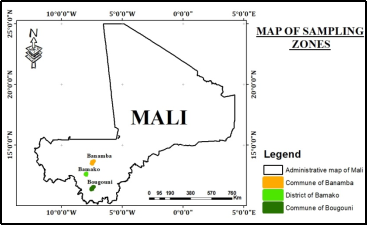
Orange peel and lemongrass leaf samples were collected from three agro-ecological zones in Mali, located between parallels 10° and 15° north latitude and meridians 5° and 10° west longitude. The Sahelian, Sudanian, and Sudano-Guinean zones were represented by the communes of Banamba, the distroct of Bamako, and the communes of Bougouni, respectively (Figure 1). These sites were chosen for their high consumption of orange and lemongrass, as well as their abundance, availability and accessibility.
Figure 1. Map of Mali showing the zones of sample collection.
2.2. Sampling Collection
Samples of orange peels and lemongrass leaves were collected from gardens and orchards in three agro-ecological zones in Mali. The Sahelian zone was represented by the Commune of Banamba, the Sudano-Guinean zone by Bougouni and the Sudanian zone by the district of Bamako (Figure 1). Freshly collected samples were packed in perforated plastic bags. After identification and authentication by “Laboratory of Tropical Ecology (LET)” at the University of Sciences, Techniques and Technologies of Bamako (USTTB), samples were carefully washed. Lastly, they were cut into smaller pieces using a stainless-steel knife to facilitate the diffusion of the essential oil through water vapor during extraction process.
2.3. Methods
2.3.1. Extraction of Essential Oils
Steam distillation (SD) has been regarded as the most common method applied for the extraction of essential oils, due to its simplicity and low investment cost .
A quantity of 1 kg of samples, freshly cut, were introduced into a flask of the “Alambic” extractor (Aura, Inox 304 - SPR-B, Troyes, France) containing 4 L of distilled water (report 1:4; m/v). The flask was heated using a gas canister to a temperature of 95 ˚C. When boiling, water vapors carried the essential oils through a stainless-steel coil immersed in a refrigerant. After 90 minutes, the essential oil-water vapor mixture (distillate) was collected. After condensation, the distillate was transferred into a decanting ampoule to separate essential oil from water.
Extraction yield was calculated using the following equation.
Yield (%) =Essential oil extracted (g)Plant material (g)× 100
2.3.2. Screening of Essential Oils by TLM
Essential oils (EO) were characterized by thin-layer chromatography (TLC). A 0.25 mm thick of aluminum-backed silica gel plate (dimension 5 x 10 cm) was used. The EO solution was prepared by dissolving 100 μL in 500 µL of absolute ethanol. Ten (10) µL of EO diluted was dispensed onto the TLC plate using a micropipette. After drying the samples on plate at room temperature (25 - 30°C), the plate was carefully placed in a migration glass tank containing the eluent, a mixture of Toluene - ethyl acetate (95-5; v/v). After approximately 2 h of elution, the plate removed from the glass tank was dried at 90°C for 10 min to completely remove the solvent. Revelation was carried out using Vanillin Reagent (1 g vanillin dissolved in 100 mL of 90% ethanol, then acidified with 2 mL of concentrated sulfuric acid). After heating at 90°C for 5 min, separated compounds (spots) were visualized using a UV light (254 nm and 365 nm). The retention factor or frontal ratio (Rf) of each spot was calculated using the following equation. Following, the Retention Factor (Rf) for each spot was calculated as the ratio of the eluted distance (mm) for a spot on TLC plate relative to the total distance (mm) that the solvent front travelled .
Retention Factor =Distance travelled (cm)Total distance (cm)
2.3.3. Essential Oils Identification and Dosage by GC-MS
Essential oils (EOs) from orange and lemongrass were identified and quantified by Gas Chromatography-Mass Spectrometry (GC-MS) method described by Chegini & Abbasipou and Owen et al. . An Agilent 7890A series G-C MS chromatograph, equipped with an automatic injector and an apolar (HP-5) column (60 m x 0.22 mm i.d. film thickness: 0.25 μm), coupled to an Agilent Turbo Mass detector. A volume of 1 µL of EO sample (EO diluted in hexane; v/v) was injected into the GC in splitless mode with an injection temperature of 280ºC. The carrier gas was helium (1 mL/min) with a column head pressure of 25 psi. The injector temperature was 250°C. The furnace temperature was programmed as follows: Initial temperature of 70°C followed by an increase of 25°C per minute to 150°C, then an increase of 5°C per minute to 200°C and a final increase of 10°C per minute until 280°C was reached. This temperature was maintained for 15 minutes. The ionization energy was 70 ev with a mass range of 35–350 Da, while the source temperature was 150°C.
Resulting EOs from analyzed samples were identified by comparing their GC retention times to those obtained from known standard reference samples of EO components, either with known compounds or published spectra in the literature. After identification, the EO components (Sigma Aldrich) were quantified by external calibration curves based on the peak area.
2.4. Statistical Analysis
All analyses were performed in triplicate and the values were represented as the means ± standard deviation (SD). One-way ANOVA was preceded by checking the normality followed by the Fischer test (p < 0.05) to compare the means using Minitab 18.1 software. Differences were considered significant if p < 0.05.
3. Results
3.1. Extraction Yields
After extracting essentials by steam distillation technique, the registered yields are depicted in the Table 1.
Table 1. Extraction yields of essentials oils (%).

Zones of harvesting

Leaves of lemongrass

Peels of orange

Sahelian

0.44±0.03a

0.50±0.03a

Sudanian

0.33±0.03b

0.32±0.01c

Sudano-Guinean

0.32±0.02b

0.43±0.01b

p-value

0.002

0.00004

F-value

21.00

82.33

* For each sample, the averages that do not share any letters are significantly different.
For each sample, EO extraction yields varied from one site to another (p-value < 0.05). The highest amount of EO were registered in Sahelian zones for both species, i.e., 0.44±0.03% for leaves of lemongrass and 0.50±0.03% for orange zests.
3.2. EO Components Profile with TLC Method
Characterization of essential oils profiling from lemongrass leaves and orange peels were assessed by TLC and GC-MS. The values of Retention Faction values are summarized in Table 2.
Retention factors values recorded from TLC allowed to detect several different EO individuals in both samples: from 10 to 15 for lemongrass and from 12 to 13 for orange. Leaves of lemongrass samples from Sahelian zone show higher EO constituents (15). As for orange peels samples, both Sahelian and Sudano-guinean presented the maximum EO components (13).
Table 2. Retention factor values from Thin Layer Chromatography (TLC).

N° spot

Essential oils from lemongrass leaves

Essential oils from orange zests

Sahelian

Sudanian

Sudano-guinean

Sahelian

Sudanian

Sudano-guinean

1

0.04

0.03

0.03

0.03

0.03

0.04

2

0.11

0.11

0.21

0.04

0.05

0.16

3

0.13

0.24

0.25

0.16

0.13

0.18

4

0.25

0.25

0.31

0.21

0.19

0.19

5

0.38

0.31

0.41

0.31

0.31

0.33

6

0.50

0.50

0.50

0.43

0.44

0.48

7

0.56

0.53

0.69

0.50

0.45

0.54

8

0.60

0.69

0.73

0.64

0.50

0.60

9

0.69

0.75

0.79

0.65

0.53

0.66

10

0.75

0.93

0.94

0.69

0.60

0.69

11

0.79

0.94

0.79

0.63

0.73

12

0.85

0.85

0.88

0.85

13

0.91

0.88

0.91

14

0.93

15

0.98

Total of components

15

11

10

13

12

13

3.3. EO Components Profile with GC-MS Method
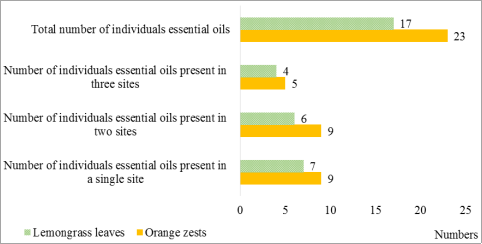
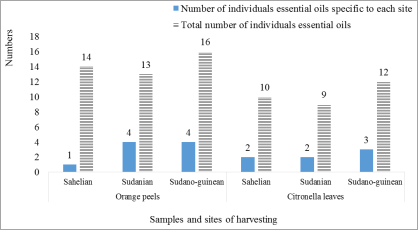
Individual EO compounds identified by GC were counted and summarized in the Figures 2 & 3. Their concentrations expressed in percentages (%) are showed in Tables 3 & 4 for lemongrass leaves and orange zests, respectively.
Figure 2. Number of individuals essential oils per site and samples.
Figure 3. Repartition of individuals essential oils per site and samples.
Table 3. Levels of individual essential oils from lemongrass leaves (%).

EO components

Zones of sample collection

Sahelian

Sudanian

Sudano-guinean

Ageratriol

1.31±0.01

Β bisabolene

9.26±0.06

10.46±0.06

Caryophyllene

12.43±0.07

7.58±0.17

Caryophyllene oxide

7.52±0.31

8.88±0.17

Citral

2.78±0.03

Citronellol

3.74±0.08

Farnesol

11.26±0.06

5.56±0.08

Geraniol

12.15±0.07

2.77±0.04

Geranyle geraniol

1.59±0.06

0.91±0.088

1.26±0.06

Humulenol

10.03±0.04

2.09±0.01

2.49±0.01

Ledol

10.19±0.04

Levomenol

11.32±0.11

1.94±0.08

6.34±0.08

Limonene

43.14±0.20

M-camphorene

19.88±0.17

17.05±0.07

Neral

17.12±0.11

36.00±0.14

4.94±0.06

Nerolidol

2.85±0.07

Trans farnesol

8.27±0.04

Total of components

10

9

12

Table 4. Levels of individual essential oils from orange peels (%).

EO components

Zones of sample collection

Sahelian

Sudanian

Sudano-guinean

Aromandendrene

10.86±0.17

Α-terpineol

3.52±0.03

11.17±0.10

Carene

4.90±0.07

Carveol

5.18±0.03

Carvone

5.04±0.08

19.59±0.58

Caryophyllene

4.21±0.07

3.47±0.04

Caryophyllene oxide

2.46±0.03

2.02±0.03

Citral

16.50±0.00

17.99±0.01

12.65±0.21

Citronellal

9.94±0.34

11.58±0.10

6.08±0.03

Citronellol

7.96±0.06

4.01±0.03

3.03±0.04

Copaene

6.78±0.31

5.34±0.20

Farnesene

3.04±0.06

3.29±0.04

2.58±0.03

Farnesol

2.72±0.03

Geraniol

5.18±0.03

Humulenol

0.71±0.01

1.21±0.03

Ledol

1.40±0.07

Limonene

9.16±0.23

6.71±0.13

3.10±0.07

Limonenol

5.69±0.16

0.75±0.01

Linalol

9.50±0.04

Neral

3.24±0.23

17.48±0.10

Nerolidol

5.31±0.13

Terpineol

12.22±0.06

8.03±0.03

5.75±0.07

Verbenol

10.76±0.34

Total of components

14

13

16

Regardless the sampling site, the gas chromatography shows a total of 23 individual EO constituents for orange zests samples and 17 for lemongrass leaves samples (Figure 2). Figure 3 reveals that samples from sudano-guinean area presented the highest number of total individual EO constituents, 16 for orange and 12 for lemongrass. Four EO molecules for lemongrass Geranyle geraniol, Humulenol, Levomenol, and Neral) (Table 3) were commonly found in all three collection sites against five EO molecules for orange (Citral, Citronellal, Citronellol, Farnesene, and Limonene) (Table 4). The number of site-specific EO molecules was higher in the Sudano-guinean site with 3 EO for lemongrass and in both Sudanian and Sudano-guinean with 4 EO (Figure 3). Lesser number of site-specific EO was registered from Sahelian areas for both lemongrass samples (Ageratriol at 1.31±0.01% and Nerolidol at 2.85±0.07%) (Table 3) and orange samples (Nerolidol with a concentration of 5.31±0.13%) (Table 4). Analyses show that the Sahelian areas had the highest levels of individual EO common to all three sites. For instance, the highest contents of Humulenol (10.03±0.04%), Levomenol (11.32±0.11%) and M-camphorene (19.88±0.17%) were registered from leaves of lemongrass (Table 3). As for peels of orange, these EO components were Terpineol with 12.22±0.06%, Citronellol with 7.96±0.06%, and Limonene with 5.69±0.16% (Table 4).
4. Discussion
This current work performed the EO profile of lemongrass leaves and orange peels harvested from different agroecological areas in Mali. It is a part of a project focused on the valorization of local and neglected resources in Mali.
Data obtained from EO extraction demonstrated the abundance of these components in lemongrass and orange. Statistical test revealed that extraction yields were zone-dependent (p-value < 0.05) and varied from 0.32 to 0.50% for analyzed samples. Sahelian areas presented the highest extraction yields, which were 0.44±0.03% and 0.50±0.03% for lemongrass leaves and orange peels, respectively.
Higher EO extraction yields of lemongrass leaves were reported by Ameh et al. using effleurage method (1.96%) and the hydro-distillation method (0.95%). As for orange peel, the yields obtained in this study were higher than those reported in literature: 4.23% with an improved distillation method ; from 0.92 to 2.73% using hydro-distillation technique ; 1.16% using microwave assisted hydrodistillation. Similar extraction yields were obtained by Kamal et al. who reported that C. sinensis had the highest oil value yield of 0.24-1.07%.
All these values recorded are lower to the expected yield mentioned in the literature, which found steam distillation yields about 3 -4% aromatic compounds . It is well known that EO extraction yields can vary according to harvesting periods, state of ripeness, climate factors, extraction method and the quality of the equipment used .
Chromatography methods enabled to identify many categories of EO components in the investigated samples. Gas chromatography (GC) technique detected more total number of different individual EO constituents in lemongrass (17) and orange (23) comparatively to TCL technique with 15 and 13 EO, respectively for lemongrass and orange. This difference could be linked to the high performance of GC technique, which is more accurate. Globally, it appears that Sahelian areas were richer in total number of individual EO constituents, regardless the samples. Lemongrass zests recorded individual EO constituents’ total number of 16 and 12 for orange peels and lemongrass leaves, respectively. In terms of individual EO diversity, Sudanian zones led with 16 and 12 for orange peels and lemongrass leaves, respectively.
GC quantification revealed that for most of the EO molecules common to the three collection zones, the highest concentrations were recorded in the Sahelian zone. These EO components were Humulenol with 10.03±0.04%, Levomenol with 11.32±0.11% and M-camphorene with 19.88±0.17% from leaves of lemongrass. Orange peels highlighted were 12.22±0.06% of Terpineol, 7.96±0.06% of Citronellol, and 5.69±0.16% of Limonene. This richness could be explained by the low moisture content in Sahelian zones, where rainfall is low (250 to 550 mm) compared to the other two zones (550 to 1100 mm) . These levels are in line with the high EO extraction yields registered in the samples collected in Sahelian areas for both species. They also corroborate literature findings which estimated that compound concentrations are generally influenced by moisture content in plant material . For a better exploitation of EO of these species, samples from this area could be very profitable.
In addition, the three most important individual EO components with higher concentrations regardless the zones were Limonene (43.14±0.20%), Neral (36.00±0.14%), and M-camphorene (19.88±0.17%) for lemongrass; carvone (19.59±0.58%), Citral (17.99±0.01%), and Neral (17.48±0.10%) for orange zests. The composition of the essential oils of C. citratus determined by GC and GC/MS were found to contain 19 and 27 constituents for samples collected in Mali and Ivory Coast, respectively . The same authors mentioned that leaves of C. citratus oil harvested in Mali presented a high proportion of citral (75%), (geranial/neral ca 2/1), some myrcene (6.2–9.1%) and geraniol (3.0–5.6%). For orange peel, the same EO constituents were observed by Olabinjo & Oliveira using GC-MS who found limonene as the predominant individual components. A study working on several EO antimicrobial sensitivity test revealed that limonene showed the most significant antibacterial effect in the growth and reproduction of S. aureus .
The composition of essential oils is generally influenced by numerous parameters. These are either natural, of internal origin (genetics, location, maturity), external (soil, climate conditions, etc.) or technological process . Likewise, ecological factors have been incriminated to influence the EO composition: geographical factors (altitude, latitude, etc.), soil type, climate (sunshine, temperature, rainfall, etc.) are all parameters responsible for variations . Othes factors such as the use of fertilizer and the presence of rhizosphere fungi in the cultivation soil have also been reported to enhance the EO levels, especially citral content .
Nowadays, food industries are facing a great challenge linked to the contamination of food products with different microbes such as bacteria, fungi, viruses, and other parasites. In several developing countries, 25–30% loss of foods and foodborne diseases caused by microbial contamination have been a major concern . This scourge pushes scientific community to find natural effective and affordable agents to manage it. In this sense, plant-based preservatives, especially EOs and their active components extracted from lemongrass and orange, are gaining cumulative attention in the food industries having wide-spectrum antibacterial, antifungal, antimycotoxicgenic, and antioxidants potentials . Work also reported the utilization of EOs as the best alternatives to chemical pesticides because of their lower toxicity on the non-target and low persistence in the environment .
Based on these benefits of EOs, the leaves of lemongrass and peels of orange could be helpful in the contribution of food security and fighting foodborne diseases due their richness in various bioactive EO agents.
5. Conclusion
This work established the composition of essential oils (EOs) in lemongrass leaves and orange zests samples harvested from three agroecological areas in Mali.
Higher extraction yields were obtained from samples collected in Sahelian zones, while those harvested from Sudano-guinean sites showed the highest number of total individual EO constituents for each species. An important profile diversity of EO components were observed in all samples. Therefore, extraction yields and EO profile were agroecological site-dependents. These data showed that lemongrass leaves and orange zests are potential sources EO constituents.
This richnes and diversity are important for choosing the area for collecting samples that willbe used for the production of natural preservatives from lemongrass leaves and orange peel in Mali.
Abbreviations

CNRST

National Center for Scientific and Technological Research

EOs

Essential Oils

EO

Essential Oil

FAPH

Faculty of Pharmacy

FCRIT

Compotitive Fund for Research and Technological Innovation

FST

Faculty of Sciences and Techniques

GC-MS

Gaz Chromatography-Mass Spectrometry

INRMPT

National Research Institute of Traditional Medicine and Pharmacopoeia

ISA

Institute of Applied Sciences

LET

Laboratory of Tropical Ecology

SD

Steam Distillation

TLC

Thin Layer Chromatography

U.PRO.CO.HE

Essential Oil Production and Marketing Unit

USTTB

University of Sciences Techniques and Technologies

UV

Ultra-Violet

Acknowledgments
This research was carried out as part of a research protocol financed by the «Competitive Fund for Research and Technological Innovation» (FCRIT) of National Center of Scientif Research and Technologies (CNRST) of the Ministry of higher Education and Scientific Research of Mali.
Author Contributions
Brahima Coulibaly: Conceptualization, Data curation, Formal Analysis, Methodology, Writing – original draft, Writing – review & editing
Cheickna Daou: Conceptualization, Funding acquisition, Investigation, Methodology, Project administration, Supervision, Validation, Writing – original draft, Writing – review & editing
Mamadou Abdoulaye Konaré: Formal Analysis, Software, Writing – review & editing
Fassé Samaké: Investigation, Supervision, Writing – original draft
Rokia Sanogo: Conceptualization, Project administration, Supervision, Validation, Writing – review & editing
Conflicts of Interest
The authors declare no conflicts of interest.
References
[1] Pandya, P., & Raja, W. (2022). Cymbopogon citrartus (Lemongrass): A Promising Pharmacognoscy, Phytochemical and Pharmacological Inception. Journal of Advancement in Pharmacology, 2(1), 20–34.
[2] Shah, G., Shri, R., Panchal, V., Sharma, N., Singh, B., & Mann, A. S. (2011). Scientific basis for the therapeutic use of Cymbopogon citratus, stapf (Lemon grass). Journal of Advanced Pharmaceutical Technology and Research, 2(1), 3–8.
[3] Manvitha, K., & Bidya, B. (2014). Review on Pharmacological Activity of Cymbopogon Citratus. International Journal of Herbal Medicine, 1(6), 5–7.
[4] Kamal, M. M., Kumar, J., Mamun, M. A. H., Ahmed, M. N. U., Shishir, M. R. I., & Mondal, S. C. (2021). Extraction and Characterization of Pectin from Citrus sinensis Peel. Journal of Biosystems Engineering, 46(1), 16–25.
[5] Boukroufa, M., Boutekedjiret, C., & Chemat, F. (2017). Development of a green procedure ofcitrus fruits waste processing to recover carotenoids. Resource-Efficient Technologies, 3(3), 252–262.
[6] Chegini, S. G., & Abbasipour, H. (2017). Chemical composition and insecticidal effects of the essential oil of cardamom, Elettaria cardamomum on the tomato leaf miner, Tuta absoluta. Toxin Reviews, 36(1), 12–17.
[7] Chaudhari, A., Singh, V., Das, S., Prasad, J., Dwivedy, A., & Dubey, N. (2020). Improvement of in vitro and in situ antifungal, AFB1 inhibitory and antioxidant activity of Origanum majorana L. essential oil through nanoemulsion and recommending as novel food preservative. Food and Chemical Toxicology, 143(111536).
[8] ACEDD, & IPEN. (2021). Rapport National sur les Pesticides Extrêmement Dangereux (HHP) au Mali: Action pour la Conservation de l’Environnement et le Développement Durable (ACEDD) – International Pollutant Elimination Network (IPEN); 55p. Bamako.
[9] FAO, & OMS. (2021). Gestion des pesticides dans l’agriculture et la santé publique - Recueil des directives de la FAO et de l’OMS et d’autres ressources. Rome.
[10] Maurya, A., Prasad, J., Das, S., & Dwivedy, A. K. (2021). Essential Oils and Their Application in Food Safety. Frontiers in Sustainable Food Systems, 5, 1–25.
[11] Kumoro, A. C., Wardhani, D. H., Retnowati, D. S., & Haryani, K. (2021). A brief review on the characteristics, extraction and potential industrial applications of citronella grass (Cymbopogon nardus) and lemongrass (Cymbopogon citratus) essential oils. IOP Conference Series: Materials Science and Engineering, 1053(012118), 1–10.
[12] Owen, L., Whit e, A. W., & Laird, K. (2019). Characterisation and screening of antimicrobial essential oil components against clinically important antibioticresistant bacteria using thin layer chromatographydirect bioautography hyphenated with GC-MS, LC-MS and NMR. Phytochemical Analysis, 30(2), 121–131.
[13] Ameh, O. E., Achika, J. I., Bello, N. M., & Owolaja, A. J. (2021). Extraction and Formulation of Perfume from Cymbopogon citratus (Lemongrass). Journal of Applied Sciences and Environmental Management, 25(8), 1461–1463.
[14] Mercy, N., Nithyalakshmi, B., & Aadhithiya, L. (2015). Extraction of Orange Oil by Improved Steam Distillation and its Characterization Studies. International Journal of Engineering Technology, Management and Applied Sciences, 3(2), 1–8.
[15] Franco-Vega, A., Ramirez-Corona, N., Palou, E., & Lopez-Malo, A. (2016). Estimation of mass transfer coefficients of the extraction process of essential oil from orange peel using microwave assisted extraction. Journal of Food Engineering, 170, 135–141.
[16] Kamal, G., Anwar, F., Hussain, A., Sarri, N., & Ashraf, M. (2011). Yield and chemical composition of Citrus essential oils as affected by drying pretreatment of peels. International Food Research Journal, 18(4), 1275–1282.
[17] Olabinjo, O. O., & Oliveira, A. L. (2020). Comparative study of extraction yield and antioxidant property of sweet orange peels (Citrus Sinesis) essential oil. Croatian Journal of Food Science and Technology, 12(2), 184–192.
[18] Guimarães, A. F., Andrade Vinhas, A. C., Ferraz Gomes, A., Humberto Souza, L., & Krepsky, P. B. (2020). Essential oil of Curcuma longa L. rhizomes chemical composition, yield variation and stability. Quimica Nova, 43(7), 909–913.
[19] PolNSAN. (2017). Politique Nationale de Sécurité Alimentaire et Nutritionnelle (PolNSAN) - Tome 2. Commissarit à la Sécurité Alimentaire. Bamako, Mali.
[20] Sidibé, L., Chalchat, J., Garry, R., Lacombe, L., & Harama, M. (2001). Aromatic Plants of Mali (IV): Chemical Composition of Essential Oils of Cymbopogon citratus (DC) Stapf and C. giganteus (Hochst.) Chiov. Journal of Essential Oil Research, 13(2), 110–112.
[21] Sengupta, S., & Pradhan, A. (2024). Exploring the Antimicrobial Properties of Lemon : A Comparative Analysis of Peel, Seed, and Pulp. 34(9), 10–24.
[22] Boukhatem, M., Amine, F., & Abdelkim, K. (2019). Méthodes d’extraction et de distillation des huiles essentielles: Revue de littérature. Revue Agrobiologia, 9(2), 1653–1659.
Cite This Article
  • APA Style

    Coulibaly, B., Daou, C., Konaré, M. A., Samaké, F., Sanogo, R. (2024). Zonal Effect on the Essential Oil Profile from Cymbopogon citratus (Lemongrass) Leaves and Citrus sinensis (Orange) Peels harvesting in Mali. Journal of Food and Nutrition Sciences, 12(5), 246-254. https://doi.org/10.11648/j.jfns.20241205.16

    Copy | Download

    ACS Style

    Coulibaly, B.; Daou, C.; Konaré, M. A.; Samaké, F.; Sanogo, R. Zonal Effect on the Essential Oil Profile from Cymbopogon citratus (Lemongrass) Leaves and Citrus sinensis (Orange) Peels harvesting in Mali. J. Food Nutr. Sci. 2024, 12(5), 246-254. doi: 10.11648/j.jfns.20241205.16

    Copy | Download

    AMA Style

    Coulibaly B, Daou C, Konaré MA, Samaké F, Sanogo R. Zonal Effect on the Essential Oil Profile from Cymbopogon citratus (Lemongrass) Leaves and Citrus sinensis (Orange) Peels harvesting in Mali. J Food Nutr Sci. 2024;12(5):246-254. doi: 10.11648/j.jfns.20241205.16

    Copy | Download

  • @article{10.11648/j.jfns.20241205.16,
      author = {Brahima Coulibaly and Cheickna Daou and Mamadou Abdoulaye Konaré and Fassé Samaké and Rokia Sanogo},
      title = {Zonal Effect on the Essential Oil Profile from Cymbopogon citratus (Lemongrass) Leaves and Citrus sinensis (Orange) Peels harvesting in Mali
    },
      journal = {Journal of Food and Nutrition Sciences},
      volume = {12},
      number = {5},
      pages = {246-254},
      doi = {10.11648/j.jfns.20241205.16},
      url = {https://doi.org/10.11648/j.jfns.20241205.16},
      eprint = {https://article.sciencepublishinggroup.com/pdf/10.11648.j.jfns.20241205.16},
      abstract = {Nowadays, Cymbopogon citratus (DC.) Staph (Poaceae), (Lemongrass) and Citrus sinensis (L.) Osbeck (Rutaceae), (orange) are very coveted for aromatic, food and medicinal purposes. Lemongrass leaves and orange zests are reputed to be rich in essential oils, which are highly prized by the food industry. The aim of this study was to determine the essential oil (EOs) extraction yields and their profile of these species collected in three agro-ecological zones of Mali. EOs were extracted by steam distillation and their profile was determined by thin layer chromatography (TLC) and gas chromatography-mass spectrometry (GC-MS). All registered data revealed zonal variation of extraction yields as well as in EO components (p-value < 0.05). Extraction yields varied from 0.32±0.02 to 0.44±0.03% for lemongrass and 0.32±0.01 to 0.50±0.03 for orange. These yields were higher in Sahelian zones for both species. Moreover, chromatography technique highlighted an important diversity of lemongrass and orange peel in individual EO components. Thus, Retention factors values recorded from TLC allowed to detect a maximum of different EO individuals: 15 for lemongrass and 13 for orange, mainly in Sahelian. Similarly with GC technique, more EO elements were found: a total of 23 for orange zests samples and 17 for lemongrass. Samples collected in Sudano-guinean sites presented the highest number of total individual EO constituents, 16 for orange and 12 for lemongrass. The major individual EO components were Limonene (43.14±0.20%), Neral (36.00±0.14%), and M-Camphorene (19.88±0.17%) for leaves of lemongrass, and carvone (19.59±0.58%), Citral (17.99±0.01%), and Neral (17.48±0.10%) for orange zests. This richness and diversity could be useful to better valorization of lemongrass leaves and orange peel in Mali.
    },
     year = {2024}
    }
    

    Copy | Download

  • TY  - JOUR
    T1  - Zonal Effect on the Essential Oil Profile from Cymbopogon citratus (Lemongrass) Leaves and Citrus sinensis (Orange) Peels harvesting in Mali
    
    AU  - Brahima Coulibaly
    AU  - Cheickna Daou
    AU  - Mamadou Abdoulaye Konaré
    AU  - Fassé Samaké
    AU  - Rokia Sanogo
    Y1  - 2024/10/31
    PY  - 2024
    N1  - https://doi.org/10.11648/j.jfns.20241205.16
    DO  - 10.11648/j.jfns.20241205.16
    T2  - Journal of Food and Nutrition Sciences
    JF  - Journal of Food and Nutrition Sciences
    JO  - Journal of Food and Nutrition Sciences
    SP  - 246
    EP  - 254
    PB  - Science Publishing Group
    SN  - 2330-7293
    UR  - https://doi.org/10.11648/j.jfns.20241205.16
    AB  - Nowadays, Cymbopogon citratus (DC.) Staph (Poaceae), (Lemongrass) and Citrus sinensis (L.) Osbeck (Rutaceae), (orange) are very coveted for aromatic, food and medicinal purposes. Lemongrass leaves and orange zests are reputed to be rich in essential oils, which are highly prized by the food industry. The aim of this study was to determine the essential oil (EOs) extraction yields and their profile of these species collected in three agro-ecological zones of Mali. EOs were extracted by steam distillation and their profile was determined by thin layer chromatography (TLC) and gas chromatography-mass spectrometry (GC-MS). All registered data revealed zonal variation of extraction yields as well as in EO components (p-value < 0.05). Extraction yields varied from 0.32±0.02 to 0.44±0.03% for lemongrass and 0.32±0.01 to 0.50±0.03 for orange. These yields were higher in Sahelian zones for both species. Moreover, chromatography technique highlighted an important diversity of lemongrass and orange peel in individual EO components. Thus, Retention factors values recorded from TLC allowed to detect a maximum of different EO individuals: 15 for lemongrass and 13 for orange, mainly in Sahelian. Similarly with GC technique, more EO elements were found: a total of 23 for orange zests samples and 17 for lemongrass. Samples collected in Sudano-guinean sites presented the highest number of total individual EO constituents, 16 for orange and 12 for lemongrass. The major individual EO components were Limonene (43.14±0.20%), Neral (36.00±0.14%), and M-Camphorene (19.88±0.17%) for leaves of lemongrass, and carvone (19.59±0.58%), Citral (17.99±0.01%), and Neral (17.48±0.10%) for orange zests. This richness and diversity could be useful to better valorization of lemongrass leaves and orange peel in Mali.
    
    VL  - 12
    IS  - 5
    ER  - 

    Copy | Download

Author Information